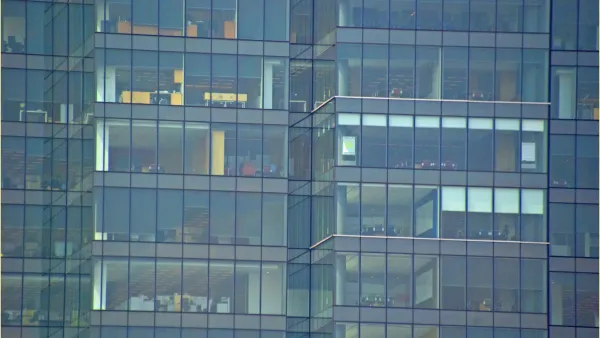
With recent developments in Astor Place, Hudson Yards, and Midtown East, Fred A. Bernstein sees a danger in New York City becoming just another a homogenous city of glass facades like Shanghai or Dubai.


"New York City is reaching a tipping point, architecturally," says Bernstein. "The city has the chance to go the way of London and Paris, where carefully chosen bits of contemporary architecture enliven an urban fabric that remains largely intact, or the way of Shanghai and Dubai, where relentless repetition of glass facades leads to a numbing sameness."
"Several recent developments suggest that New York, for all its attention to the built environment—and 12 years of a design-savvy administration—is choosing the latter approach, permitting continuous walls of glass to erase the city’s history and leave its citizens with little to reflect on but reflections," he warns.
Read the full story: Commentary: Glazing Over New York

Protecting Birds From Window Glass
Glass windows kill billions of birds each year. Simple fixes can help.

The Biggest Hazard to Birds in New York City—Buildings
In New York City, tens of thousands of birds die each year after colliding with buildings. Policy and design measures can make the city much safer for its feathered inhabitants.
Why We're Not Meant to Live in Boring Cities
Features like blank street facades literally turn us off, decreasing mental stimulation and bringing on restlessness and stress. Research points to worrying consequences for people who find their city, well, boring.

Planetizen Federal Action Tracker
A weekly monitor of how Trump’s orders and actions are impacting planners and planning in America.

California plans to bury El Niño’s downpour
If the state plays its cards right, it may be able to store a billion acre-feet of El Niño’s water in aquifers.

Desperate measures: Advocates weigh draining Lake Powell to fill Colorado River
Draining the reservoir could reduce evaporation losses by a couple hundred thousand acre-feet.

Mamdani’s pied-à-terre tax survives legal challenge
A panel of judges found that the plaintiffs failed to demonstrate injury as a result of New York City's implementation of the tax.

Eastern Nebraska is running out of electricity
Data centers and electrification are straining eastern Nebraska’s grid, throttling economic development.

Seattle passes record-breaking transit services expansion
Proposition 1 will double the city’s transit tax to add 95,000 more bus trips and preserve 180,000 bus trips annually.

FREE Course: Walkable City 1: Why Walkability?
After describing his path towards focusing on walkability as the essence of good planning, Jeff Speck marches through his five principal reasons for making more walkable places.
Reinventing Malls: Planning Alchemy—Turning Gray Fields Into Gold
The course focuses on the opportunities and imperatives that shape reinvention of mall sites.

City of Rosemead
Rutgers University, Edward J. Bloustein School of Planning and Public Policy
One Hundred Miles
University of Michigan School for Environment and Sustainability (SEAS)
Hunter College, City University of New York (CUNY)
The Architects Foundation
City of Cambridge
Montrose County
The Pocatello Development Authority