One theme unites the winners of the My LA2050 competition: a desire to reinvigorate Los Angeles’s vacant and underused spaces.


The competition, sponsored by the Goldhirsh Foundation, awarded $100,000 each to ten ideas for improving Los Angeles within the next 37 years. The winners include top designs in eight categories, plus two wildcard picks.
Among the projects awarded grants are four that will transform neglected spaces into engines of the city’s revitalization. The housing category winner, TRUST South LA, will buy up abandoned homes in South LA and rehabilitate them, adding a second house to each site.
LA Open Acres will create a network through which local residents can identify underused spaces and transform them into community assets.
CicLAvia will keep doing what it already does, creating temporary festival spaces through its bike parades.
Finally, the Hammer Museum will create a pop-up artists’ colony this summer at Westwood Village, which has the highest retail vacancy rate in the city.
“No single $100,000 project is going [to] make LA a utopia in 2050, of course,” writes Eve Bachrach, “but the hope is that each of the projects will start a small change in its community that will help make LA a happier, healthier, fairer place.”
Read the full story: 2050 LA Will Be Doing So Much More With Its Underused Space
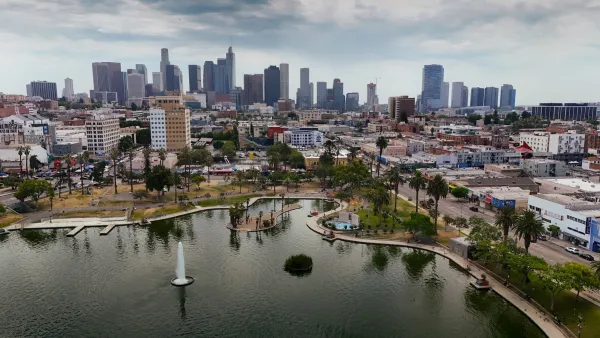
World Cup renews community spirit in LA's MacArthur Park
Soccer watch parties are bringing life back to the park that was recently the target of immigration raids and police actions.
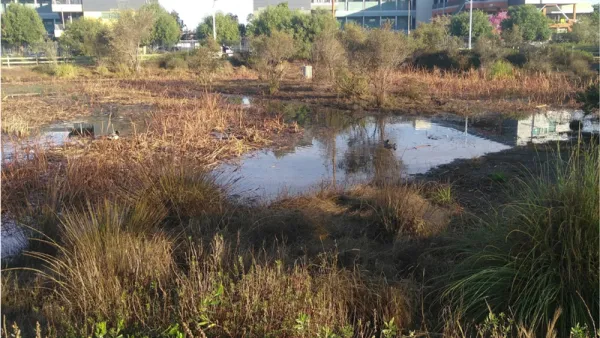
How South LA Green Spaces Power Community Health and Hope
Green spaces like South L.A. Wetlands Park are helping South Los Angeles residents promote healthy lifestyles, build community, and advocate for improvements that reflect local needs in historically underserved neighborhoods.
Private Donations Propel Early Restoration of Palisades Playground
Los Angeles has secured over $1.3 million in private funding to restore the Pacific Palisades playground months ahead of schedule, creating a modern, accessible space that supports community healing after recent wildfires.

Planetizen Federal Action Tracker
A weekly monitor of how Trump’s orders and actions are impacting planners and planning in America.

California plans to bury El Niño’s downpour
If the state plays its cards right, it may be able to store a billion acre-feet of El Niño’s water in aquifers.

Desperate measures: Advocates weigh draining Lake Powell to fill Colorado River
Draining the reservoir could reduce evaporation losses by a couple hundred thousand acre-feet.

Mamdani’s pied-à-terre tax survives legal challenge
A panel of judges found that the plaintiffs failed to demonstrate injury as a result of New York City's implementation of the tax.

Eastern Nebraska is running out of electricity
Data centers and electrification are straining eastern Nebraska’s grid, throttling economic development.

Seattle passes record-breaking transit services expansion
Proposition 1 will double the city’s transit tax to add 95,000 more bus trips and preserve 180,000 bus trips annually.

FREE Course: Walkable City 1: Why Walkability?
After describing his path towards focusing on walkability as the essence of good planning, Jeff Speck marches through his five principal reasons for making more walkable places.
Reinventing Malls: Planning Alchemy—Turning Gray Fields Into Gold
The course focuses on the opportunities and imperatives that shape reinvention of mall sites.

City of Rosemead
Rutgers University, Edward J. Bloustein School of Planning and Public Policy
One Hundred Miles
University of Michigan School for Environment and Sustainability (SEAS)
Hunter College, City University of New York (CUNY)
The Architects Foundation
City of Cambridge
Montrose County
The Pocatello Development Authority