Inga Saffron tells the frustrating tale of how the owner of a lucrative billboard can derail an apartment tower planned for Philly's Old City neighborhood that planners have enthusiastically endorsed.


"It is, to be sure, a very lucrative billboard," notes Saffron. "Owned by Keystone Outdoor Advertising of Cheltenham, the three-sided display rises 150 feet above a traffic island in Old City at the Race Street entrance to I-95. Two of the billboards are positioned so they are visible for roughly eight seconds to every motorist crossing the Ben Franklin Bridge."
"Sure, the apartment tower could shave some valuable time off their visibility," she continues. "It might even block them entirely from certain angles. On the other hand, the project would make Old City a better place to live. The building would occupy a large lot alongside the bridge that has been empty far too long. It would restore the streetscape with ground-floor retail and greatly strengthen connections to the developing Delaware waterfront."
Changes to the building that were made to accommodate the wishes of the billboard's owners have increased its height by 25 feet, rankling the Old City Civic Association.
"Instead of focusing solely on building height, we ought to be asking why a deep-pocketed billboard company gets to call the shots. Philadelphia exists as a place to live and work, not as a backdrop for advertisers," implores Saffron.
Read the full story: Changing Skyline: A billboard stalls Philadelphia apartment tower
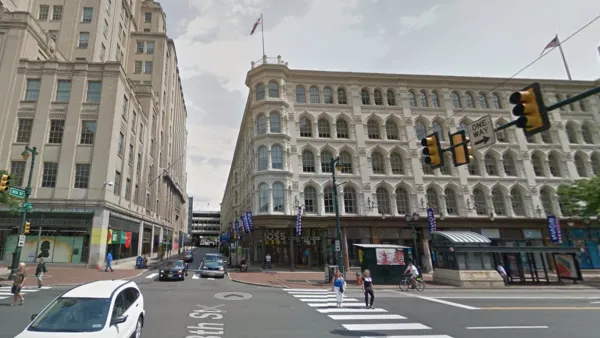
Billboards Having a Moment in Philadelphia
A proposal to add billboard advertisements to a pair of city-owned buildings come at a time when residents, and the federal government, are already concerned about the proliferation of billboards in the city.
Coming Soon to Philadelphia's Center City: 3D Digital Advertisements
A Philadelphia City Council committee approved a controversial proposal to allow "Urban Experiential Displays" (i.e., large, 3D digital advertisements) in Center City.
'Urban Experiential Displays' Proposed for Philadelphia’s Center City
An outdoor advertising company has crafted legislation, expected for City Council review, to allow electronic displays at seven locations in Center City.

Planetizen Federal Action Tracker
A weekly monitor of how Trump’s orders and actions are impacting planners and planning in America.

California plans to bury El Niño’s downpour
If the state plays its cards right, it may be able to store a billion acre-feet of El Niño’s water in aquifers.

Desperate measures: Advocates weigh draining Lake Powell to fill Colorado River
Draining the reservoir could reduce evaporation losses by a couple hundred thousand acre-feet.

Los Angeles just elected an urban planner as its mayor
Transportation analysts are optimistic that Raman will be more aggressive in addressing transit issues than Bass.

Mamdani’s pied-à-terre tax survives legal challenge
A panel of judges found that the plaintiffs failed to demonstrate injury as a result of New York City's implementation of the tax.

Eastern Nebraska is running out of electricity
Data centers and electrification are straining eastern Nebraska’s grid, throttling economic development.

FREE Course: Walkable City 1: Why Walkability?
After describing his path towards focusing on walkability as the essence of good planning, Jeff Speck marches through his five principal reasons for making more walkable places.
Reinventing Malls: Planning Alchemy—Turning Gray Fields Into Gold
The course focuses on the opportunities and imperatives that shape reinvention of mall sites.

City of Rosemead
Rutgers University, Edward J. Bloustein School of Planning and Public Policy
One Hundred Miles
University of Michigan School for Environment and Sustainability (SEAS)
Hunter College, City University of New York (CUNY)
The Architects Foundation
City of Cambridge
Montrose County
The Pocatello Development Authority