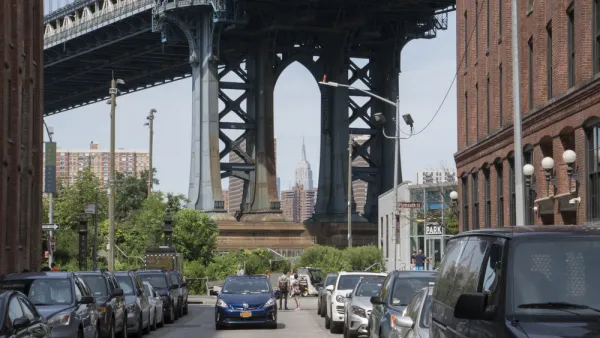
In Brooklyn's Dumbo neighborhood, NYCDOT is looking to replace the area's historic cobblestones with artificially aged new ones to improve accessibility and bike-friendliness. Preservationists and residents are aghast at the "phony urbanism."


"[A]mid efforts to make the rickety streets of Dumbo and Vinegar Hill more accessible and bike-friendly, the city has delivered a disquieting message to residents who say they were drawn to the neighborhoods for their historic feel: Many of the old cobblestones on their streets have to go," writes Matt Flegenheimer.
"Some of the original Belgian blocks have already been replaced with more uniform stones, including ones cut with machines and lasers, startling preservationists," he adds. "In a compromise that has not eased all minds, the city’s Department of Transportation has offered to install new cobbles that are aged artificially, like a pair of stonewashed jeans, to appear more worn."
“'It is far worse than I could have imagined,' said Andrew S. Dolkart, director of the historic preservation program at Columbia University, decrying the 'phony urbanism' of the replacement stones. 'It is appalling that the D.O.T. would destroy real historic material and replace it with a completely ersatz program.'”
Read the full story: To Replace Old Cobblestones, Old-Looking Cobblestones

‘Instagrammed to Death’ or a Return to Pre-Pandemic Normal?
Familiar controversies might seem reassuring in 2022.
Cobblestones vs. Bike and Pedestrian Improvements Controversy in Brooklyn
Improving streets in Sunset Park by removing cobblestones and aging train tracks has created a controversy between historic preservation and the need for safe bike and walking facilities and other streetscape improvements.
Pedestrian and Bike Improvements Coming to Brooklyn's DUMBO Neighborhood
The New York City Department of Transportation is moving forward with a series of pedestrian and bike infrastructure improvements in a neighborhood built in the shadow of some of the city's most highest profile transportation infrastructure.

Planetizen Federal Action Tracker
A weekly monitor of how Trump’s orders and actions are impacting planners and planning in America.

California plans to bury El Niño’s downpour
If the state plays its cards right, it may be able to store a billion acre-feet of El Niño’s water in aquifers.

Desperate measures: Advocates weigh draining Lake Powell to fill Colorado River
Draining the reservoir could reduce evaporation losses by a couple hundred thousand acre-feet.

In Texas, data centers are swallowing promised parkland
Residents who moved to Taylor, Texas for a rural community now have to contend with three data centers in their backyard.

How a Chicago-sized wind farm beat the odds and powered on
The project spanned five presidential administrations and a standoff with a U.S. military base.

MTA gives itself 30 days to transform pit into basketball court
The site has been under construction since 2022; the city originally estimated it would finish the court in 2024.

FREE Course: Walkable City 1: Why Walkability?
After describing his path towards focusing on walkability as the essence of good planning, Jeff Speck marches through his five principal reasons for making more walkable places.
Reinventing Malls: Planning Alchemy—Turning Gray Fields Into Gold
The course focuses on the opportunities and imperatives that shape reinvention of mall sites.

City of Rosemead
Rutgers University, Edward J. Bloustein School of Planning and Public Policy
One Hundred Miles
Hunter College, City University of New York (CUNY)
The Architects Foundation
University of Cincinnati Online
City of Cambridge
Montrose County
The Pocatello Development Authority