The conversion of an historic art deco baseball stadium in Indianapolis into loft apartments is one of the most inventive adaptive re-use projects we've ever seen.


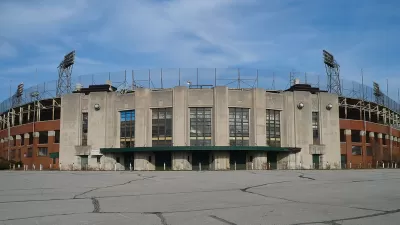
Sitting at the edge of Indianapolis' burgeoning 16 Tech district, "a formerly industrial area now housing many of Indianapolis’ technology and life sciences companies," abandoned Bush Stadium (1931) was a prime candidate for redevelopment. Rather than tear down the historic art deco ballpark, Indianapolis-based Heartland Design is working on a "creative adaptive reuse project will fill its grandstand not with fans but with loft apartments," reports Branden Klayko.
“'We preserved quite a bit of the stadium,' said James Cordell, principal at Heartland, noting his belief that the project is the first conversion of a stadium to housing. 'It’s just a very unusual thing to do'.”
The $22 million Stadium Lofts project, which is due to open to residents this August, has found inventive ways to incorporate the stadium's unique shape in its varied apartment layouts. "The design [also] preserves the stadium’s quirky features and iconic elements, including its old scoreboard, press box, and lighting towers. Ticket booths and offices are being converted into common areas. The baseball diamond, remade in earth-tone concrete and grass, remains as a green space for residents."
FULL STORY: Home Plate

Chicago Amtrak funding makes way for new White Sox stadium
The new funding is the first step in Amtrak vacating its 14th Street rail yard, the future development site of a new baseball stadium.
Indianapolis rents grew by 30% since 2020
The metro area has a shortage of roughly 137,000 affordable homes for the lowest-income households.
Indianapolis could establish special zoning district for data centers
A city commission advanced a proposal that would establish guardrails for data centers within city limits.

Planetizen Federal Action Tracker
A weekly monitor of how Trump’s orders and actions are impacting planners and planning in America.

The state-sanctioned urbicide of Austin
People don’t kill cities. Freeways do.

US to reduce Colorado River water deliveries to Mexico
A new Colorado Treaty amendment reduces Mexico’s Colorado River water allocation by 250,000 acre feet.

Mamdani overhauls NYC's Vision Zero plan with 100 new policy goals
The overhaul aims to reduce traffic deaths and make streets safer for pedestrians, cyclists and drivers through lower speed limits, new safety infrastructure and more.

Amtrak not solely to blame for New Jersey commuter rail's unreliability, report finds
A new study from the Garden State Initiative found that NJ Transit’s budget grew 20% across a 4 year period, but reliability declined significantly over the same period.

EPA erases limits on planet-warming pollution from power plants
Under Monday’s plan, power plants would still have some limits on how much mercury, arsenic and other contaminants they can emit.

FREE Course: Walkable City 1: Why Walkability?
After describing his path towards focusing on walkability as the essence of good planning, Jeff Speck marches through his five principal reasons for making more walkable places.
Reinventing Malls: Planning Alchemy—Turning Gray Fields Into Gold
The course focuses on the opportunities and imperatives that shape reinvention of mall sites.


Eagle County Government
Harvard University Graduate School of Design
Nashville Planning Department
The Architects Foundation
University of Cincinnati Online
The Pocatello Development Authority
The Urban Renewal Agency of the City of Pocatello
Journal of the American Planning Association