The variety of designs found in the Berlin subway's 173 stations imbibes each one with its own unique identity. Cataloging this 'underground art gallery' has been the mission of photographer Kate Seabrook.


Henry Grabar discusses photographer Kate Seabrook's "Endbahnhof," a tumblr page that captures the interiors of every station along the the Berlin U-Bahn. According to Grabar, the site is "like flipping through a paint-sample catalog of pattern, typography and architecture."
"The stations aren't as exquisite as those of St. Petersburg, or as bombastic as those of Stockholm -- their design variance is quieter, more approachable, and some would argue, more fitting for a utilitarian transport system," he comments. "And while Munich has constructed some of the most radiant underground stations in the world, the Bavarian city's network is only half the size of Berlin's and offers none of the timeworn contrasts -- it dates from 1971; Berlin's from 1902."
"No, traveling through the Berlin U-Bahn is a more subtle trip, a journey through fonts, graphic design, tile-work, molding and color. And, cliche though it may be, history."
Read the full story: Berlin's Subway: 'An Underground Art Gallery'
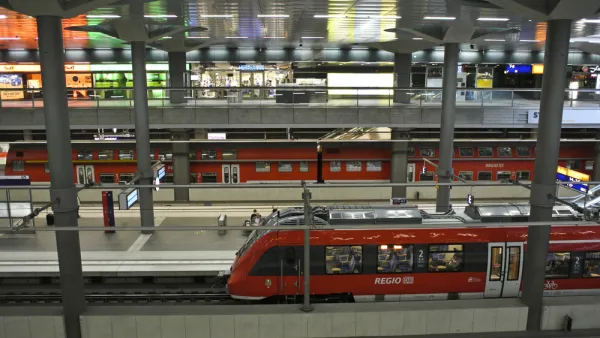
Berlin's Transit Future Just Got Even Brighter
Berlin is committing to a huge investment in its public transit infrastructure. Kiwi-living-in-Berlin author and lawyer Leah Hamilton writes about it.

Berlin Plans Massive Investment in Rail
A new Transit Master Plan will spend approximately €2 billion a year on tram, rail, and bus improvements.
Friday Funny: Masking the Smells of Public Transit
Stinky trains may become a thing of the past in Berlin, where officials are sniff-testing new fragrances to mask the odors of public transit.

Planetizen Federal Action Tracker
A weekly monitor of how Trump’s orders and actions are impacting planners and planning in America.

Eastern Nebraska is running out of electricity
Data centers and electrification are straining eastern Nebraska’s grid, throttling economic development.

Move over, LA: St. Louis gears up for Olympics, invests millions in downtown redevelopment
The Missouri city will host the 2028 Olympic soccer group stage and knockout matches.

Dallas releases zoning code overhaul to officials
The drafted overhaul is over 400 pages long.

NYC renovations for dangerous, ‘mercilessly crammed’ street delayed until 2027
Construction was supposed to begin this fall.

San Diego’s Midway Rising project gets greenlight from city council
The project looks to become the largest affordable housing development in California's history.

FREE Course: Walkable City 1: Why Walkability?
After describing his path towards focusing on walkability as the essence of good planning, Jeff Speck marches through his five principal reasons for making more walkable places.
Reinventing Malls: Planning Alchemy—Turning Gray Fields Into Gold
The course focuses on the opportunities and imperatives that shape reinvention of mall sites.

City of Rosemead
Rutgers University, Edward J. Bloustein School of Planning and Public Policy
One Hundred Miles
University of Michigan School for Environment and Sustainability (SEAS)
Hunter College, City University of New York (CUNY)
The Architects Foundation
City of Cambridge
The Pocatello Development Authority
The Urban Renewal Agency of the City of Pocatello