In news that's sure to please active transportation advocates, outgoing Transportation Secretary Ray LaHood announced his agency will ditch AASHTO's outdated guidelines and develop its own standards for bicycle and pedestrian safety.


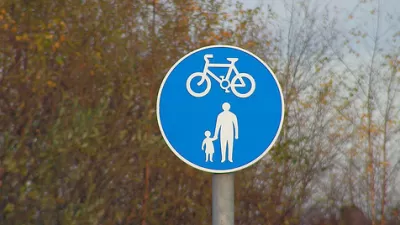
Tanya Snyder provides some background and reports on the Secretary's recent announcement, which, interestingly, was made at the American Association of State Highway and Transportation Officials' (AASHTO) annual Washington conference.
"For years, the federal government has adopted roadway guidelines [based on AASHTO's Green Book] that fall far short of what’s needed — and what’s possible — to protect cyclists and pedestrians," says Snyder. "By 'playing it safe' and sticking with old-school engineering, U.S. DOT allowed streets to be unsafe for these vulnerable road users."
"In FHWA’s new round of rule-making, DOT will set its own bicycle and pedestrian safety standards for the first time. The agency will 'highlight bicycle and pedestrian safety as a priority,' LaHood said."
"It’s a big step for U.S. DOT to craft its own bicycle and pedestrian safety standards, and it’s especially positive that the move started under a secretary that sees biking and walking as equal to driving in the transportation world," adds Snyder.
“We know that people are cycling more and walking more, and that pedestrian and cycling safety has to be a priority,” he told the audience at AASHTO yesterday. “We must ensure that our streets, bridges and highways are safe whether we’re in a car or on a bike.”
Read the full story: U.S. DOT to Challenge AASHTO Supremacy on Bike/Ped Safety Standards

Proposed Bill Would Direct Funds to Road Safety
The Sarah Debbink Langenkamp Active Transportation Safety Act was spurred by the death of a U.S. diplomat who was killed on her bicycle.

Data Shows Chicago Speed Cameras Reduce Speeding, Crashes
Countering claims made by the Chicago Tribune that automated enforcement doesn’t improve safety, Streetsblog Chicago lays out the data showing how traffic safety fared in camera zones.

Seattle Recorded Zero Bike Deaths in 2024, per Early Data
The city halved the number of pedestrian deaths compared to 2021.

Planetizen Federal Action Tracker
A weekly monitor of how Trump’s orders and actions are impacting planners and planning in America.

Eastern Nebraska is running out of electricity
Data centers and electrification are straining eastern Nebraska’s grid, throttling economic development.

Study reveals best places in the U.S. for cycling, walking
New research from Streetlight Data examines bicycle and pedestrian miles per capita in the 100 largest U.S. cities by population.

DSA members accuse Mamdani of 'abandoning values' over housing redevelopment
New York City's mayor plans to replace about 2,000 units of public housing with private, mixed-income housing.

All sides of BRT debate unhappy with CDOT’s most recent move
The Colorado Department of Transportation is no longer considering center-running bus lanes for Colorado Boulevard.

Massachusetts bogs generate both power, and cranberries
Putting solar panels above farmland is one way Massachusetts is advancing toward its goal of net-zero carbon emissions by 2050.

FREE Course: Walkable City 1: Why Walkability?
After describing his path towards focusing on walkability as the essence of good planning, Jeff Speck marches through his five principal reasons for making more walkable places.
Reinventing Malls: Planning Alchemy—Turning Gray Fields Into Gold
The course focuses on the opportunities and imperatives that shape reinvention of mall sites.

City of Rosemead
Rutgers University, Edward J. Bloustein School of Planning and Public Policy
One Hundred Miles
University of Michigan School for Environment and Sustainability (SEAS)
Hunter College, City University of New York (CUNY)
The Architects Foundation
City of Cambridge
The Pocatello Development Authority
The Urban Renewal Agency of the City of Pocatello