Cartographic Grounds, a recent exhibition at the Harvard Graduate School of Design — now online at Places — seeks to "reconcile the precision and instrumentality of the plan with the geographic and territorial scope of the map."


"The ascendance of 'mapping' and data visualization in design culture has changed the way architects, landscape architects and urban designers communicate ideas about buildings and landscapes, often privileging abstract forces and flows over the material conditions of the site," writes curator Jill Desimini. "We have an even greater challenge now, as our drawings are required to be interactive, to make sense of big data, and to describe increasingly complex systems."
"As design extends its purview to cartography, it is time once again to look closely at maps and plans, to immerse ourselves in their beauty but also to uncover their projective potential."
Desimini explores a range of cartographic practices, from a 13th-century view of the British Isles to contemporary data visualization.
FULL STORY: Cartographic Grounds: Projecting the Landscape Imaginary

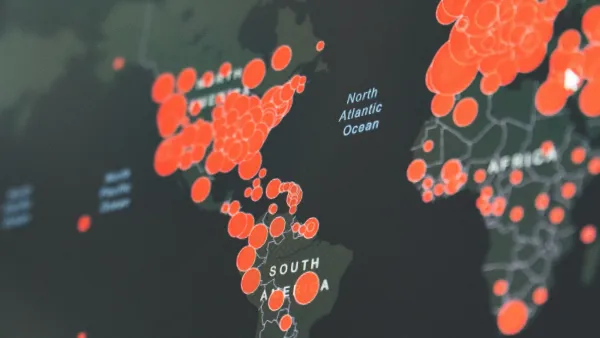
Visualizing the Coronavirus Pandemic
Mapping of the crisis is producing a fascinating and important trove of cartographic records.

Friday Eye Candy: Full-Color, HD Videos Taken from Space
For the first time, full-color videos of the earth's surface will be made available to the public, with added options for paying customers. The imagery comes from two cameras on the International Space Station.
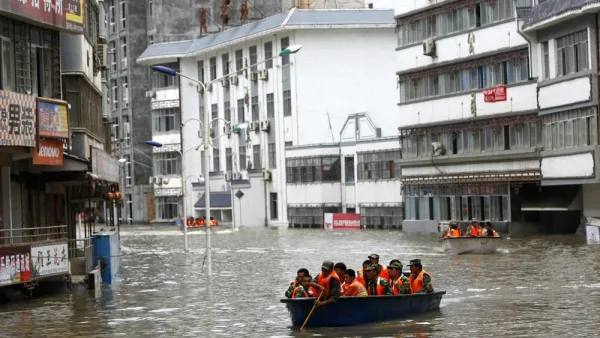
China Submerged: Mapping Nightmare Sea Levels
Cartographer Jeffrey Linn has compiled maps of how coastal China would look under risen seas. Over 40 percent of the country's population lives in potentially affected regions.

The state-sanctioned urbicide of Austin
People don’t kill cities. Freeways do.

US to reduce Colorado River water deliveries to Mexico
A new Colorado Treaty amendment reduces Mexico’s Colorado River water allocation by 250,000 acre feet.

New Jersey’s second-largest city bans standalone data centers
Jersey City will continue to allow co-location facilities, such as those meant for research institutions that store their own data.

Amtrak not solely to blame for New Jersey commuter rail's unreliability, report finds
A new study from the Garden State Initiative found that NJ Transit’s budget grew 20% across a 4 year period, but reliability declined significantly over the same period.

EPA erases limits on planet-warming pollution from power plants
Under Monday’s plan, power plants would still have some limits on how much mercury, arsenic and other contaminants they can emit.

Phoenix announces new on-demand transit service, more frequent RAPID buses
Both new services will launch in October, and are part of Phoenix's Project Effective Access Solutions for Easing Congestion.

FREE Course: Walkable City 1: Why Walkability?
After describing his path towards focusing on walkability as the essence of good planning, Jeff Speck marches through his five principal reasons for making more walkable places.
Reinventing Malls: Planning Alchemy—Turning Gray Fields Into Gold
The course focuses on the opportunities and imperatives that shape reinvention of mall sites.

Eagle County Government
Harvard University Graduate School of Design
Nashville Planning Department
The Architects Foundation
University of Cincinnati Online
The Pocatello Development Authority
The Urban Renewal Agency of the City of Pocatello
Journal of the American Planning Association