Happiness and health are generated or depleted by the way our neighbourhoods, towns, cities, and rural landscapes are developed. Creative placemaking adds to walkable urbanism by sealing the deal on physical, mental, and social well-being.


PlaceShakers has been running a series on a proposed Urban Happiness Index or Healthy Place Index. Hazel Borys turns an eye toward her own inspirations in great cycling cities, cycling through nature, gardening, retail streets, travel, living outdoors, cottage living, and art, and goes on to say:
"For me personally, places that generate the highest levels of mental and social well-being are the outcomes of creative placemaking, a discipline recently getting an injection of capital from ArtPlace. It’s a private-public consortium providing 'a means of investing in art and culture at the heart of a portfolio of integrated strategies that can drive vibrancy and diversity so powerful that it transforms communities.'"
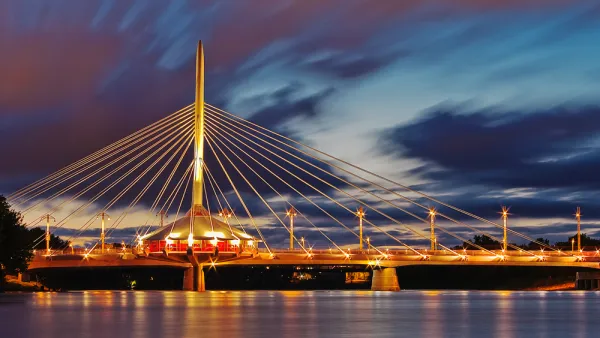
Borys goes on to review a public art piece that opened last week in Winnipeg, From Here Until Now. Her parting warning:
"One of the pickets in the bridge reads, 'Affluence creates poverty,' a quote from the great Canadian philosopher of communication theory, and former area resident, Marshall McLuhan. While we have a long way to go to mitigate the gentrification inherent in creative placemaking outcomes, it’s worth figuring given the other significant value-driving benefits to health, environment, and economy. Not to mention the simple satisfaction of the experience."
Read the full story: Creative Placemaking: From Here Until Now
Inclusive Cities: Inclusion Equals Diversity Plus Equity
Hazel Borys sharing ideas from thought leaders on inclusion and indigeneity.
Green Cities: Breathe Deeply and Walk Freely
Greening the city extends our life and increases our quality of life.
Creative Placemaking: Preserve, Repair, Intensify
Many cities have long been investing in art and culture, marrying it to placemaking, and generating extraordinary local transformations. Hazel Borys offers up a little inspiration from an art opening this week, and a few pointers for urbanists.

Desperate measures: Advocates weigh draining Lake Powell to fill Colorado River
Draining the reservoir could reduce evaporation losses by a couple hundred thousand acre-feet.

Eastern Nebraska is running out of electricity
Data centers and electrification are straining eastern Nebraska’s grid, throttling economic development.

Malls are becoming the midtowns of the future
Mall and office park redevelopments are a generational opportunity to create new nodes of urbanity.

NYC breaks ground on anti-flooding infrastructure project
New York City's new system will reduce stormwater flows to local sewers by 90%.

One Kentucky town’s secret to affordable housing
The Smoketown Community Land Trust has already built seven affordable homes for community members.

Houston gains petal-shaped cooling infrastructure to make streets more ‘delightful’
The city has installed the pavilions along 15 blocks in Houston.

FREE Course: Walkable City 1: Why Walkability?
After describing his path towards focusing on walkability as the essence of good planning, Jeff Speck marches through his five principal reasons for making more walkable places.
Reinventing Malls: Planning Alchemy—Turning Gray Fields Into Gold
The course focuses on the opportunities and imperatives that shape reinvention of mall sites.

City of Rosemead
Rutgers University, Edward J. Bloustein School of Planning and Public Policy
One Hundred Miles
University of Michigan School for Environment and Sustainability (SEAS)
Hunter College, City University of New York (CUNY)
The Architects Foundation
City of Cambridge
Montrose County
The Pocatello Development Authority