A change made last month in the regulations concerning which buildings the Federal Housing Administration (FHA) judges to be eligible for financing could enable the construction of more mixed-use walkable developments, reports Angie Schmitt.


According to Schmitt, the FHA has finally loosened restrictions on the amount of commercial space a condominium project could have and still be eligible for financing, "thanks in large part to the efforts of groups like Congress for the New
Urbanism and the National Association of Realtors."
"FHA loosened a restriction that forbade government-backed loans from
supporting condominium projects that contained more than 25 percent
commercial space. New rules will allow credit to flow to projects with
up to 35 percent commercial space - or 50 percent in certain cases where
the developer applies for an exemption." The outdated restrictions, says Schmitt, "have hampered the growth of mixed-use housing."
"This is one indication that FHA is making big strides," said CNU
spokesperson Benjamin Schulman. "We view this as the first step in this
long process to reform the regulation."
Read the full story: Federal Housing Administration Clears Way for More Walkable Development

Beyond Zoning: Obstacles to Walkable Neighborhood Development
If the market demand is there, why isn't more mixed-use housing getting built? Follow the money.
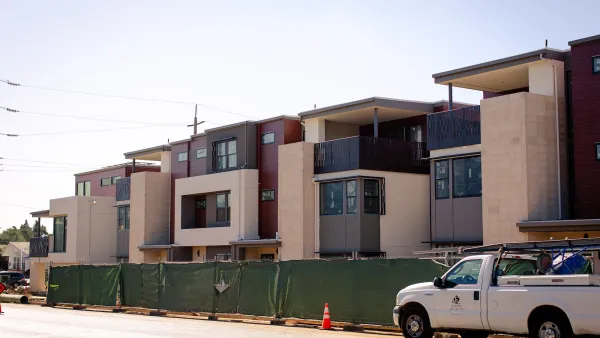
40,000 California Housing Units are Stuck in ‘Financial Purgatory’
A lack of sufficient funding is holding back the construction of hundreds of ‘shovel-ready’ projects.

Missoula Approves Zoning Reform Emphasizing More Diverse Housing, Walkability
The city’s new zoning code, map, and development standards will guide more expansive housing options and improved walkability.

Planetizen Federal Action Tracker
A weekly monitor of how Trump’s orders and actions are impacting planners and planning in America.

Amtrak, CN end decades-long dispute with eight-year agreement
The new operating agreement establishes an updated framework for the companies to work together, including processes to resolve disputes.

Northwest rail fans eager for Sept. 30 debut of Amtrak’s Airo fleet
Get ready for that new train smell and more seats. But they won’t go faster or run more frequently on the Cascades route in Washington and Oregon.

Brightline Florida files for bankruptcy
The transit company is over $5 billion in debt.

St. Louis Metro to test if single-car trains can reduce operating costs, maintain rider satisfaction
The pilot program will run from October to spring 2027, and begin with one single-car train operating on Metrolink’s Red and Blue lines.

Pennsylvania is building data centers in abandoned mines
Housing data centers in mines provides an alternative to destroying local forests and may spare residents from data centers’ noise and air pollution.

FREE Course: Walkable City 1: Why Walkability?
After describing his path towards focusing on walkability as the essence of good planning, Jeff Speck marches through his five principal reasons for making more walkable places.
Reinventing Malls: Planning Alchemy—Turning Gray Fields Into Gold
The course focuses on the opportunities and imperatives that shape reinvention of mall sites.

City of Thousand Oaks
City of Wisconsin Rapids
Harvard University Graduate School of Design
The Architects Foundation
University of Cincinnati Online
The Pocatello Development Authority
The Urban Renewal Agency of the City of Pocatello