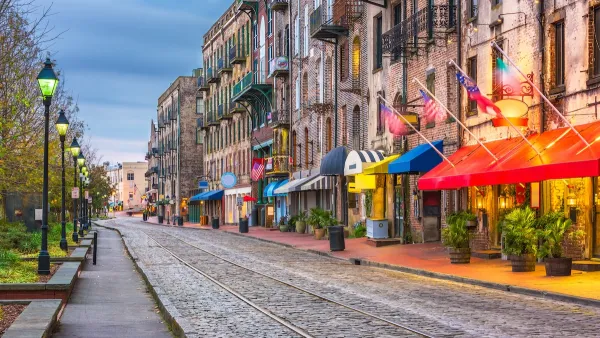
Lively walkable streets teeming with tourists bouncing between unique stores make Savannah's downtown the envy of many cities. But this state of affairs hasn't always been the case. Greg Bluestein looks at the secrets to Savannah's success.


Bluestein credits several factors, including "a renewed focus on the 'creative class' and Savannah College of Art & Design's unorthodox growth strategy" for sparking the city's downtown resurgence.
By buying and restoring several vacant and aging historic buildings spread throughout the city, SCAD has created "a disconnected campus that still manages
to feel unified, spreading youth and energy across the city."
Another key element in downtown's renaissance has been "a renewed emphasis on creative types, from artists to tech ventures,
who call Savannah home," says Bluestein. The city has funded a non-profit called Creative Coast, helmed by Jake Hodesh, that "helps
small companies push city policy, find investors and network with other
local businesses, an echo effect that can help draw other creative
industries to town."
"Savannah is creating its own modern identity. It's no longer Savannah
1733 – it's Savannah 2012," said Hodesh. "It's a much more laid-back,
smaller version of the expensive town you're used to living in."
Thanks to Daniel Lippman
Read the full story: Savannah’s surging downtown defies downturn

Georgia DOT Studying Atlanta-to-Savannah Train
The agency is studying the potential of intercity rail, with Atlanta as a strategic Amtrak hub.
Savannah Reduces Speed Limits on Almost 100 City Streets
The historic Georgia city is lowering speed limits in an effort to reduce road fatalities.
Savannah: A City of Planning Contrasts
From a human-scales, plaza-anchored grid to suburban sprawl, the oldest planned city in the United States has seen wildly different development patterns.

Planetizen Federal Action Tracker
A weekly monitor of how Trump’s orders and actions are impacting planners and planning in America.

California plans to bury El Niño’s downpour
If the state plays its cards right, it may be able to store a billion acre-feet of El Niño’s water in aquifers.

Chicago breaks ground on $3 billion megadevelopment
The new neighborhood, titled Foundry Park, will one day host 3,700 residences.

California High-Speed Rail Authority CEO resigns after $600,000 scandal
Under Ian Choudri, the authority used taxpayer dollars to fund first class flights and trips to nightclubs.

Want to study the Missouri River? Soon, you may need unanimous approval from 10 states
Legislation would require 10 governors’ permission to study or build projects moving water outside the basin.

Desperate measures: Advocates weigh draining Lake Powell to fill Colorado River
Draining the reservoir could reduce evaporation losses by a couple hundred thousand acre-feet.

FREE Course: Walkable City 1: Why Walkability?
After describing his path towards focusing on walkability as the essence of good planning, Jeff Speck marches through his five principal reasons for making more walkable places.
Reinventing Malls: Planning Alchemy—Turning Gray Fields Into Gold
The course focuses on the opportunities and imperatives that shape reinvention of mall sites.

City of Rosemead
Rutgers University, Edward J. Bloustein School of Planning and Public Policy
One Hundred Miles
Hunter College, City University of New York (CUNY)
The Architects Foundation
University of Cincinnati Online
City of Cambridge
Montrose County
The Pocatello Development Authority