Conservative news outlets are recirculating a controversial speech made by President Obama in 2007, highlighting his remark that "We don’t need to build more highways out in the suburbs." Brad Plumer looks at the policy implications of his statement.


With the Daily Caller, and several other conservative news outlets, calling attention to Obama's remarks on transportation policy contained in the speech, Plumer discusses the bipartisan arguments supporting the President's brief remarks.
"Many transportation experts, both liberal and conservative, have been
arguing against building more highways out into the suburbs for years.
The idea is that we should generally focus our dollars on fixing and
upgrading existing infrastructure rather than continuing to build
sprawling new roads."
"Yet as president, Obama has pushed his preferred approach only halfheartedly - his American Jobs Act proposal contained
about $50 billion in infrastructure spending, of which a good chunk,
$27 billion, would go toward 'rebuilding roads and bridges.'...More generally, the highway bill that Obama signed didn't do much to shift funding from suburban highways to inner-city transit."
"In any case," concludes Plumer, "this all might be reading too much into what Obama meant
by his line. But there's a strong policy case that we could stand to
build fewer new highways out to the suburbs, at least for the time
being."
Read the full story: ‘We don’t need to build more highways out in the suburbs’
Is Obama Out to Abolish the Suburbs?
Stanley Kurtz traces the mechanisms by which he believes President Obama intends to "abolish" the suburbs in a possible second term, and the roots of his desire, stretching back to his training as a community organizer.
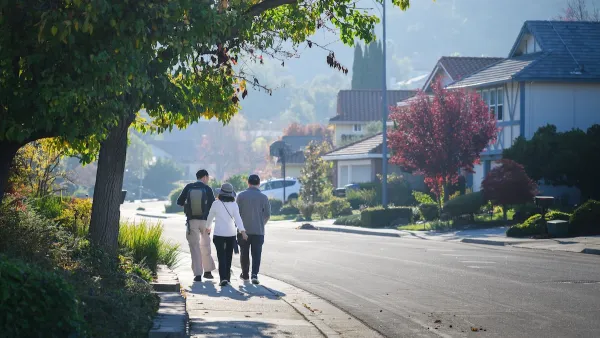
Will sprawl save California?
California residents will vote on Proposition 45 in November, which would make it easier to build large housing developments on the outskirts of the state’s cities.
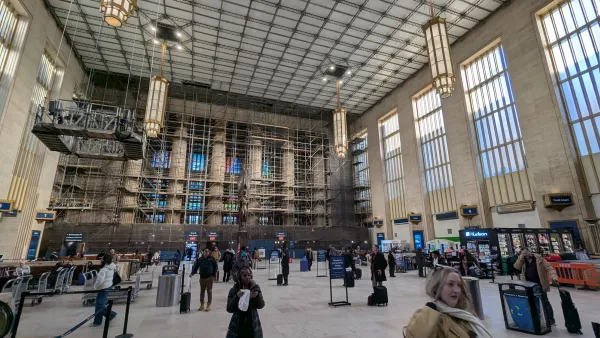
Pennsylvania 12-year transportation plan commits $13B for transit
The state's new mid-range transportation strategy includes nearly $17 billion for roads and bridges and $367 million for multimodal projects.

Planetizen Federal Action Tracker
A weekly monitor of how Trump’s orders and actions are impacting planners and planning in America.

Eastern Nebraska is running out of electricity
Data centers and electrification are straining eastern Nebraska’s grid, throttling economic development.

Study reveals best places in the U.S. for cycling, walking
New research from Streetlight Data examines bicycle and pedestrian miles per capita in the 100 largest U.S. cities by population.

DSA members accuse Mamdani of 'abandoning values' over housing redevelopment
New York City's mayor plans to replace about 2,000 units of public housing with private, mixed-income housing.

All sides of BRT debate unhappy with CDOT’s most recent move
The Colorado Department of Transportation is no longer considering center-running bus lanes for Colorado Boulevard.

Massachusetts bogs generate both power, and cranberries
Putting solar panels above farmland is one way Massachusetts is advancing toward its goal of net-zero carbon emissions by 2050.

FREE Course: Walkable City 1: Why Walkability?
After describing his path towards focusing on walkability as the essence of good planning, Jeff Speck marches through his five principal reasons for making more walkable places.
Reinventing Malls: Planning Alchemy—Turning Gray Fields Into Gold
The course focuses on the opportunities and imperatives that shape reinvention of mall sites.

City of Rosemead
Rutgers University, Edward J. Bloustein School of Planning and Public Policy
One Hundred Miles
University of Michigan School for Environment and Sustainability (SEAS)
Hunter College, City University of New York (CUNY)
The Architects Foundation
City of Cambridge
The Pocatello Development Authority
The Urban Renewal Agency of the City of Pocatello