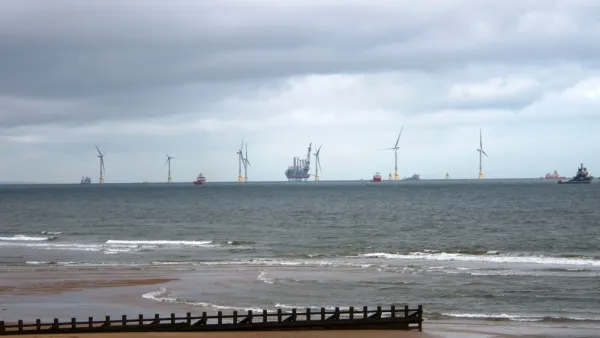
Terry Macalister reports on the £4.5bn plan to construct 339 turbines covering 300 square kilometres off Scotland's northern coast, which could potentially power 40% of the country's homes.


Recently submitted for planning permission, the 1.5-gigawatt wind farm to be located more than 12 miles offshore, "is being developed by Moray Offshore Renewables, a joint venture between
Spanish oil company Repsol, and an arm of Portuguese power group EDP,
which has recently become partly owned by China's state-owned Three
Gorges Corporation."
According to Macalister, "The renewable industry has hailed it as a watershed moment but warned
these new deep water farms might only be fully realised if the
government provides policy stability by pushing through its proposed Energy Bill."
Apparently, the wind farm has at least one prominent critic. "It has already attracted controversy because it is opposed by American
billionaire Donald Trump, who says the 200-metre-high turbines will
spoil the view from his planned new golf course."
Read the full story: World's biggest offshore windfarm planned off Scottish coast

Morro Bay Could be Home to West Coast's First Offshore Wind Farm
If a Seattle company gets its way, in a few years there will be 100 floating wind turbines about 15 miles off San Luis Obispo County on the central California coast, generating about 1 gigawatt of electricity.
Trump Huffs and Puffs about Scottish Offshore Wind Project
Donald Trump says he will sue to prevent the construction of an offshore wind farm that government officials claim will boost the local economy and meet half of residential energy needs in Aberdeen, Scotland.
Offshore Wind Power Projects Face Financial Headwind
As offshore wind projects along the East Coast stall, so do the country’s emissions reduction goals.

Planetizen Federal Action Tracker
A weekly monitor of how Trump’s orders and actions are impacting planners and planning in America.

Amtrak, CN end decades-long dispute with eight-year agreement
The new operating agreement establishes an updated framework for the companies to work together, including processes to resolve disputes.

Judges permit Denver to divert 77,000 acre feet from the Colorado River for reservoir expansion
Overuse and climate change have caused the Colorado River’s water levels to plummet.

Philadelphia to invest $2 billion into upgrading city airports as PHL places last in customer satisfaction
Modernizations to Philadelphia's airports will include baggage system upgrades and a new automated parking garage guidance system.

The LA housing policies making developers turn away from the city
Despite LA’s housing shortage, developers say the city’s "mansion-tax" and pandemic-era policies make it an unappealing place to build housing.

New density bill would require 7 California cities to establish regional transit hubs
The bill would also require major cities in California to permit high-rise residential buildings.

FREE Course: Walkable City 1: Why Walkability?
After describing his path towards focusing on walkability as the essence of good planning, Jeff Speck marches through his five principal reasons for making more walkable places.
Reinventing Malls: Planning Alchemy—Turning Gray Fields Into Gold
The course focuses on the opportunities and imperatives that shape reinvention of mall sites.

City of Wisconsin Rapids
Harvard University Graduate School of Design
KFH Group Inc.
The Architects Foundation
University of Cincinnati Online
The Pocatello Development Authority
The Urban Renewal Agency of the City of Pocatello