Dogged in advance of the Olympics by fears of transit paralysis, Lauren Collins discusses how London's public transportation network has been the surprise hit of the Games.


It seems as though London's much maligned temperamental transit system has been a surprising hit of the games, not just with spectators, but with the athletes themselves, who have been spotted on trains showcasing their newly earned Olympic hardware.
According to Collins, "The trendlet got off to a start last week when the Venezuelan fencer
Rubén Limardo beat the Norwegian Bartosz Piasecki to win the individual
épée contest. After the match, still wearing his gold medal around his
neck, he proceeded directly to the Docklands Light Railway."
"Lashinda Demus, the Team U.S.A. hurdler (she won silver on Wednesday
night in the four-hundred metres), has been commuting each day from her
rental apartment to Olympic Park on the 257 bus," notes Collins. 'I simply like riding
on public transport,' she said, according the the Evening Standard, explaining why she'd chosen to forgo the chauffeured BMWs and empty lanes
on offer to members of what is being called 'the Olympic family.' She
continued, 'It's only a couple of stops to where I am staying.'"
Even the superstar USA Men's Basketball team were caught taking the high-speed Javelin train from the Olympic Park into town.
Read the full story: Mind the Gap (and the Gold Medal)
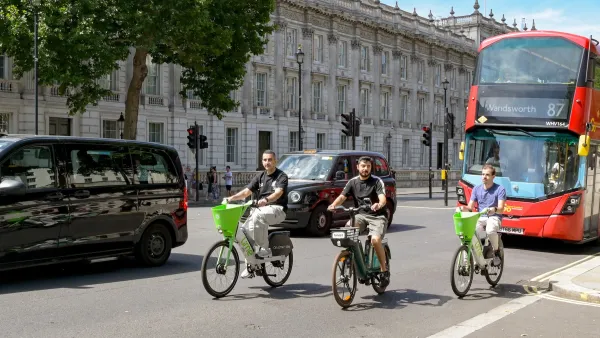
Bike use in London grew by 43% since 2019, but car use remains roughly the same
The city's efforts to reduce car use have stalled despite ambitious programs like congestion pricing and low-traffic neighborhoods.

Beavers save London Tube station from flooding
A small group of beavers is increasing biodiversity and creating cost-free flood mitigation infrastructure.
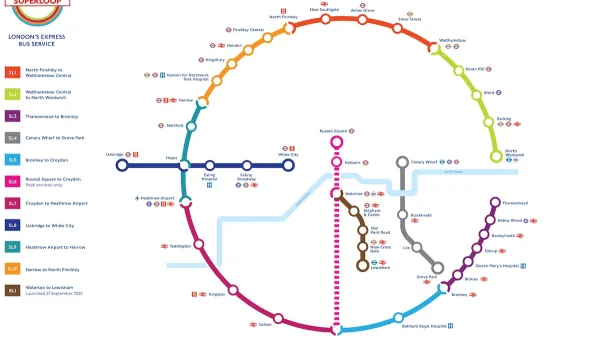
London’s Superloop BRT Ridership Grows by 20% While Other Bus Ridership Declines
The new rapid bus system launched its first suburban line, the first of 10 that will extend outside central London.

Planetizen Federal Action Tracker
A weekly monitor of how Trump’s orders and actions are impacting planners and planning in America.

California plans to bury El Niño’s downpour
If the state plays its cards right, it may be able to store a billion acre-feet of El Niño’s water in aquifers.

Desperate measures: Advocates weigh draining Lake Powell to fill Colorado River
Draining the reservoir could reduce evaporation losses by a couple hundred thousand acre-feet.

Los Angeles just elected an urban planner as its mayor
Transportation analysts are optimistic that Raman will be more aggressive in addressing transit issues than Bass.

Mamdani’s pied-à-terre tax survives legal challenge
A panel of judges found that the plaintiffs failed to demonstrate injury as a result of New York City's implementation of the tax.

Eastern Nebraska is running out of electricity
Data centers and electrification are straining eastern Nebraska’s grid, throttling economic development.

FREE Course: Walkable City 1: Why Walkability?
After describing his path towards focusing on walkability as the essence of good planning, Jeff Speck marches through his five principal reasons for making more walkable places.
Reinventing Malls: Planning Alchemy—Turning Gray Fields Into Gold
The course focuses on the opportunities and imperatives that shape reinvention of mall sites.

City of Rosemead
Rutgers University, Edward J. Bloustein School of Planning and Public Policy
One Hundred Miles
University of Michigan School for Environment and Sustainability (SEAS)
Hunter College, City University of New York (CUNY)
The Architects Foundation
City of Cambridge
Montrose County
The Pocatello Development Authority