In case the everyday theater of urban street life isn't quite adequate in an age of $200 million Hollywood blockbusters, a design collective from Auckland, New Zealand has created a way to turn any stoop into a mini cinema.


AJ Artemel introduces the "Stairway Cinema," a pop-up cinema designed by OH.NO.SUMO. According to Artemel, "The micro-theater is grafted onto an existing stoop such that the stairs
become seats (for up to seven people) and films, selected by viewers,
are projected onto the canopy while pedestrians pass below. The cinema
doubles as a refuge from rain, and as an incubator of random social
encounters."
We're a little dubious about the need to introduce yet another screen onto streets already overrun with cell phone gazing pedestrians. But Artemel claims, "The project aims to encourage people to trade private screens for one
somewhat more public, as the project uses social media to reintroduce
interaction into the physical public realm."
Read the full story: A Sidewalk Theater for the Socially Challenged


Zoning Reform: Lessons From New Zealand
The island nation is mandating mid-density zoning requirements and transit-oriented development in an effort to increase housing affordability and encourage compact development.
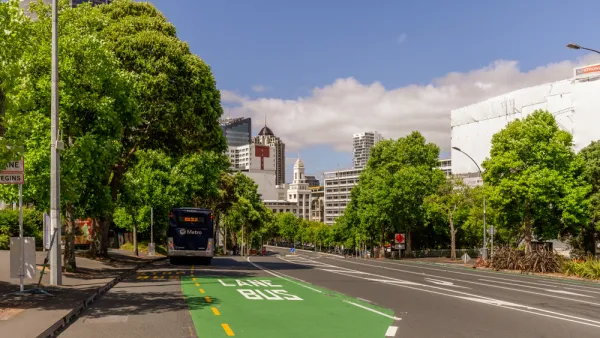
Smashing Transit Ridership Success in New Zealand
The city of Auckland, in New Zealand, set a goal to double its transit ridership in ten years. With a little under four years left to achieve that goal, the city is already well on its way.
New Zealand Bars Foreigners from Buying Residences
Homes are getting more expensive in New Zealand, so they're making it illegal for foreigners to buy homes in the country.

Planetizen Federal Action Tracker
A weekly monitor of how Trump’s orders and actions are impacting planners and planning in America.

Amtrak, CN end decades-long dispute with eight-year agreement
The new operating agreement establishes an updated framework for the companies to work together, including processes to resolve disputes.

Judges permit Denver to divert 77,000 acre feet from the Colorado River for reservoir expansion
Overuse and climate change have caused the Colorado River’s water levels to plummet.

NYC DOT wants faster, more permanent street upgrades
The city is examining ways to build more concrete infrastructure without getting entangled in 'decades-long' projects.

'Something we’ve never seen before:' rising utility rates could strain city finances nationwide
Data centers, climate change and other factors have caused utility rates in the United States to increase by 38% since 2020.

Trump to overrule local leaders, lease millions of acres of America’s Pacific Island territories’ seafloors to mining companies
International law says that the Indigenous people of America’s territories have a right to prior and informed consent regarding projects that impact their countries.

FREE Course: Walkable City 1: Why Walkability?
After describing his path towards focusing on walkability as the essence of good planning, Jeff Speck marches through his five principal reasons for making more walkable places.
Reinventing Malls: Planning Alchemy—Turning Gray Fields Into Gold
The course focuses on the opportunities and imperatives that shape reinvention of mall sites.

Harvard University Graduate School of Design
KFH Group Inc.
Greater Baltimore Committee
The Architects Foundation
University of Cincinnati Online
The Pocatello Development Authority
The Urban Renewal Agency of the City of Pocatello