Award-wining author Taras Grescoe pens an opinion piece for the Los Angeles Times in which he makes an argument that may surprise many Angelenos - that their city is at the cutting edge of forward-thinking transportation planning in the U.S.


Author of the recent book "Straphanger: Saving Our Cities and Ourselves From the Automobile", Grescoe tells Angelenos what he's been telling the world - that Los Angeles is the U.S. city "working hardest to improve transit."
"Many Angelenos are surprised to learn that their city's reputation is at
an all-time high among international transit scholars. This is the
place, after all, that consistently ranks first in measures of commuter
stress, as well as in hours wasted in traffic."
"Outsiders may see freeway-driven sprawl, but metropolitan Los Angeles is
actually more densely settled, over its entire urban area, than the New
York-Newark metro area. That makes the area ideally suited for the
transit revival its leaders are trying to foster."
"The real fight in Los Angeles is not going to be over issues such as
methane pockets under Beverly Hills High," says Grescoe, "but over whether street space
now given over to the private automobile will go to public transit."
"The
drivers I talked to in Los Angeles all acknowledged that their city
needed better transit. But, they admitted, that didn't mean they planned
on using it themselves. Too often, unfortunately, transit is seen as
something the other person ought to be using."
Read the full story: L.A. -- transit's promised land
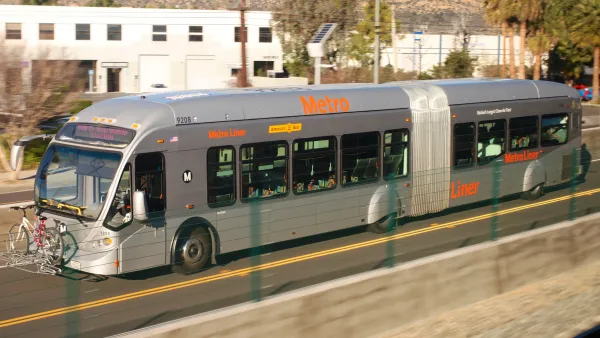
Los Angeles May Upgrade Orange Line BRT to Rail
The San Fernando Valley's Orange Line bus rapid transit enjoys solid ridership. For an area of the city especially under-served by trains, investing in light rail might be a viable option.
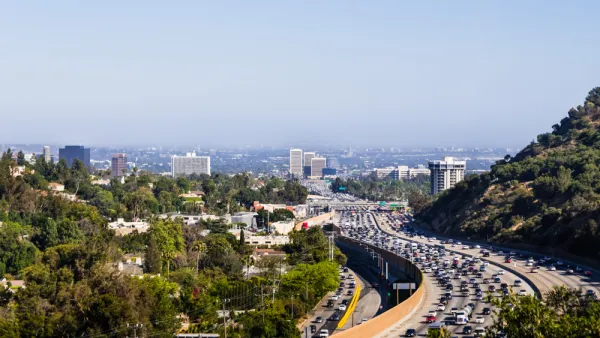
New Price Tag for L.A's Biggest Rail Dream: $13 Billion
The Sepulveda Transit Corridor could offer tens of thousands of Los Angeles commuters an alternative to the infamously congested I-405 freeway, if local officials can find the funding.
Auto Companies Prepare for Decline of Car Ownership
It's no longer just transit agencies that are trying to meet the first mile-last mile challenge—auto companies have also jumped in by offering "mobility services." And it's more profitable than selling cars!

Desperate measures: Advocates weigh draining Lake Powell to fill Colorado River
Draining the reservoir could reduce evaporation losses by a couple hundred thousand acre-feet.

Eastern Nebraska is running out of electricity
Data centers and electrification are straining eastern Nebraska’s grid, throttling economic development.

Move over, LA: St. Louis gears up for Olympics, invests millions in downtown redevelopment
The Missouri city will host the 2028 Olympic soccer group stage and knockout matches.

Mass. votes against statewide minimum lot size for single-family homes
Over 2 million residents voted on Question 7; it was decided by just over 30,000 votes.

Maryland’s $15 billion bridge project gains key approval
The Maryland Transit Authority said the project will create over 60,000 jobs and add $23 billion to the local economy.

‘No clear next steps’ for Chicago's permanent festival grounds
Eleventh Ward Ald. Nicole Lee has suggested Soldier Field as a possible location for the permanent event space.

FREE Course: Walkable City 1: Why Walkability?
After describing his path towards focusing on walkability as the essence of good planning, Jeff Speck marches through his five principal reasons for making more walkable places.
Reinventing Malls: Planning Alchemy—Turning Gray Fields Into Gold
The course focuses on the opportunities and imperatives that shape reinvention of mall sites.

City of Rosemead
Rutgers University, Edward J. Bloustein School of Planning and Public Policy
One Hundred Miles
University of Michigan School for Environment and Sustainability (SEAS)
Hunter College, City University of New York (CUNY)
The Architects Foundation
City of Cambridge
Montrose County
The Pocatello Development Authority