On Tuesday, the Loudoun County Board of Supervisors voted 5-4 to support extending D.C.'s Metrorail to Dulles Airport, ending months of uncertainty over the project's fate.


The narrow vote was crucial to securing the extension of Metro's Silver Line to some of Northern Virginia's fastest growing suburbs, and to D.C.'s only airport not served by rail. "Without Loudoun's commitment to contribute nearly $270 million toward construction costs, the second part of the long-planned project would have been in jeopardy," writes Caitlin Gibson.
"For a once-rural community that has become one of the fastest-growing counties in the nation, it is a significant step for Loudoun - one that has been championed by many Loudoun residents and business leaders and especially by young adults, who have said that access to the District is a key factor for 20- and 30-something professionals looking to settle in the suburbs."
"When completed, at a projected cost of $6 billion, the Silver Line will span 23 miles of rail between East Falls Church and Ashburn, providing Loudoun with a rail link to the rest of the metropolitan area."
Read the full story: Loudoun board votes to support Silver Line
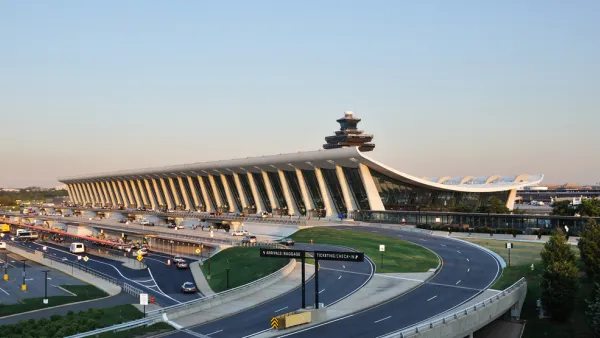
New Rail Line Connects D.C. Area to Dulles Airport
The Silver Line extends passenger train service into Loudon County and adds new connections to the region’s airports.
More Delays and Costs for D.C. Metro's Silver Line Extension
An already difficult project received bad news at the end of April in the form of long delays and huge cost overruns. Now Phase 2 of the Silver Line extension is expected to arrive in Loudon County, Virginia in 2020.
Transformation of D.C. Area Commute On Track for This Year
With construction of the D.C. subway system's newest extension 90 percent complete, the Silver Line is set to transform the region's transportation patterns, and Northern Virginia's in particular.

Planetizen Federal Action Tracker
A weekly monitor of how Trump’s orders and actions are impacting planners and planning in America.

California plans to bury El Niño’s downpour
If the state plays its cards right, it may be able to store a billion acre-feet of El Niño’s water in aquifers.

Desperate measures: Advocates weigh draining Lake Powell to fill Colorado River
Draining the reservoir could reduce evaporation losses by a couple hundred thousand acre-feet.

Mamdani’s pied-à-terre tax survives legal challenge
A panel of judges found that the plaintiffs failed to demonstrate injury as a result of New York City's implementation of the tax.

Eastern Nebraska is running out of electricity
Data centers and electrification are straining eastern Nebraska’s grid, throttling economic development.

Seattle passes record-breaking transit services expansion
Proposition 1 will double the city’s transit tax to add 95,000 more bus trips and preserve 180,000 bus trips annually.

FREE Course: Walkable City 1: Why Walkability?
After describing his path towards focusing on walkability as the essence of good planning, Jeff Speck marches through his five principal reasons for making more walkable places.
Reinventing Malls: Planning Alchemy—Turning Gray Fields Into Gold
The course focuses on the opportunities and imperatives that shape reinvention of mall sites.

City of Rosemead
Rutgers University, Edward J. Bloustein School of Planning and Public Policy
One Hundred Miles
University of Michigan School for Environment and Sustainability (SEAS)
Hunter College, City University of New York (CUNY)
The Architects Foundation
City of Cambridge
Montrose County
The Pocatello Development Authority