Want to know how long it will take to pick up the kids at school, drive to your favorite restaurant, drive the baseball game, take the bus to the park? And all at once? Trulia's new innovative map does just that.


Want to know where exactly you can and can't go in the next hour? Trulia's new map service can show you a "heat-map" of the places you can travel within a certain time limit, and by either public transit or by automobile.
As Mark Wilson of Fast Company reports, "...in a single search, you can spot the congestion of an entire city and plan your day accordingly...Maybe you're a tourist in a new town. You'd like to hit up some sites, but you have no idea how much time to plan. Or maybe you're juggling errands on the weekend, and you want to hit up whichever stores are lightest on traffic first."
After some playing around with the maps, and reading the comments of other users, the maps do seem to be off in some ways. Arrival times for suburban and rural areas tend to be drastically misjudged, usually off by twice the normal time it would take to get there by automobile. But, for larger and traffic-clogged metros at peak rush hours, the times seem to be, for the most part, correct.
As one commenter put it, "[r]oadway classification seems to be downplayed too much, as in local streets moving almost as fast as major arterials. Are signalized or signed intersections assigned impedance values?...what time of day is this? Is this a weekday or a weekend? I hope under/overpasses are uncoupled. The data is out there to support such an analysis, but it will cost you dear." Still, it's worth a try.
Read the full story: Trulia’s New Maps Show Your Commute Time From Your New House

Friday Funny: Cartographers Are Hiding an Idyllic Continent
The rest of the world would only spoil it for the mapmakers.
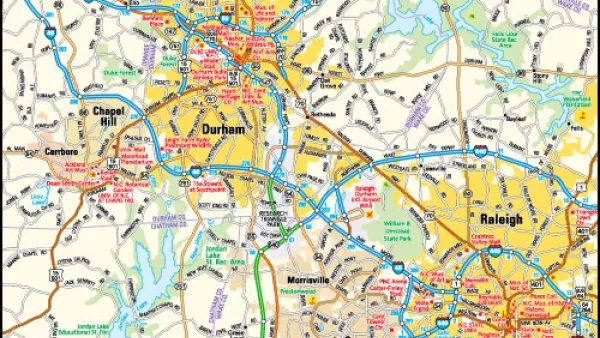
Friday Eye Candy: Highly Detailed Cold War Era Soviet Maps of the U.S.
A new book sheds light on maps created by cartographers in the Soviet Union that dove into remarkable detail about buildings, transportation networks, and other infrastructure in cities across the United States and around the world.

Friday Eye Candy: The Childhood Maps of 8 Professional Mapmakers
Choosing cartography as a career is a natural result of a lifelong love of maps. National Geographic gathers the proof.
Planetizen Federal Action Tracker
A weekly monitor of how Trump’s orders and actions are impacting planners and planning in America.

Eastern Nebraska is running out of electricity
Data centers and electrification are straining eastern Nebraska’s grid, throttling economic development.

Study reveals best places in the U.S. for cycling, walking
New research from Streetlight Data examines bicycle and pedestrian miles per capita in the 100 largest U.S. cities by population.

DSA members accuse Mamdani of 'abandoning values' over housing redevelopment
New York City's mayor plans to replace about 2,000 units of public housing with private, mixed-income housing.

All sides of BRT debate unhappy with CDOT’s most recent move
The Colorado Department of Transportation is no longer considering center-running bus lanes for Colorado Boulevard.

Massachusetts bogs generate both power, and cranberries
Putting solar panels above farmland is one way Massachusetts is advancing toward its goal of net-zero carbon emissions by 2050.

FREE Course: Walkable City 1: Why Walkability?
After describing his path towards focusing on walkability as the essence of good planning, Jeff Speck marches through his five principal reasons for making more walkable places.
Reinventing Malls: Planning Alchemy—Turning Gray Fields Into Gold
The course focuses on the opportunities and imperatives that shape reinvention of mall sites.

City of Rosemead
Rutgers University, Edward J. Bloustein School of Planning and Public Policy
One Hundred Miles
University of Michigan School for Environment and Sustainability (SEAS)
Hunter College, City University of New York (CUNY)
The Architects Foundation
City of Cambridge
The Pocatello Development Authority
The Urban Renewal Agency of the City of Pocatello