In a pattern being repeated across Canada's major cities, office tenants are willing to pay a premium to be located close to transit in Vancouver and buildings located only a few blocks away or in suburban office parks are seeing a rise in vacancies.


Frances Bula describes the findings of two new studies conducted by the real estate services firm Jones Lang Lasalle, that look at the importance of transit in the Vancouver market.
According to Bula, "The latest of their [JLL's] 'rapid transit office index' reports concluded that tenants are willing to pay considerably more to get into a similar building that's closer to transit."
"The statistics-stuffed report concluded that tenants will pay a 22-per-cent premium in Vancouver, Surrey and Burnaby, three of the largest office markets, to be within 500 metres of a transit station. As well, vacancy rates for buildings outside that 500-metre range can go up to 25 per cent higher than a transit-oriented building in the same suburb."
Desperate business parks are increasingly providing shuttles to the nearest transit station to try to retain tenants.
"What we are hearing from tenants most often these days is that priority one is access to transit and it can't even be a walk down the street," says Brett Miller, president of Jones Lang Lasalle Real Estate Services in Canada.
Thanks to Brent Toderian
Read the full story: Transit-oriented buildings fetch higher rents
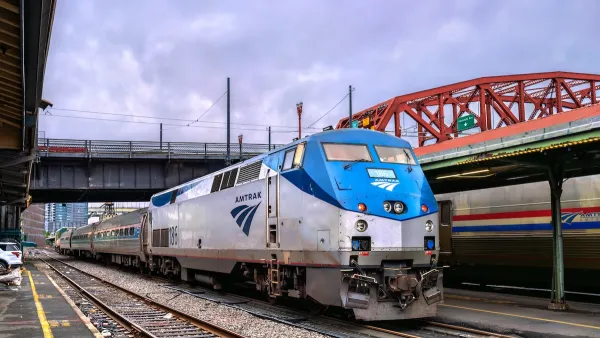
Transit leaders progress high-speed rail from Portland to Vancouver, B.C.
Washington state officials may reveal feasible routes for the high-speed rail in late 2027.
Budget constraints threaten light rail for Oregon, Washington’s new bridge
The current proposal includes only the infrastructure for the light rail, without funding for the train and tracks.
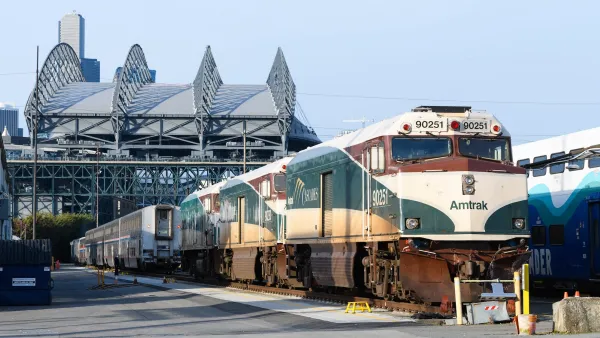
Amtrak opens border preclearance facility for travelers entering US from Vancouver
The first-of-its-kind facility streamlines the border crossing experience, eliminating long waits.

Planetizen Federal Action Tracker
A weekly monitor of how Trump’s orders and actions are impacting planners and planning in America.

California plans to bury El Niño’s downpour
If the state plays its cards right, it may be able to store a billion acre-feet of El Niño’s water in aquifers.

Desperate measures: Advocates weigh draining Lake Powell to fill Colorado River
Draining the reservoir could reduce evaporation losses by a couple hundred thousand acre-feet.

Housing is the top priority of Seattle’s sole new councilmember
Jenks campaigned on building 1,000 new units of affordable housing.

New tax cuts may slash $1.5 billion in funding for Miami transit, public parks
Amendment 3 will save Miami-Dade homeowners $2,700 in 2028.

Arizona, Wisconsin, Pennsylvania hope to finally advance climate goals post-midterms
The three states have spent years under Republican or divided control.

FREE Course: Walkable City 1: Why Walkability?
After describing his path towards focusing on walkability as the essence of good planning, Jeff Speck marches through his five principal reasons for making more walkable places.
Reinventing Malls: Planning Alchemy—Turning Gray Fields Into Gold
The course focuses on the opportunities and imperatives that shape reinvention of mall sites.

City of Rosemead
Rutgers University, Edward J. Bloustein School of Planning and Public Policy
One Hundred Miles
University of Michigan School for Environment and Sustainability (SEAS)
Hunter College, City University of New York (CUNY)
The Architects Foundation
City of Cambridge
Montrose County
The Pocatello Development Authority