Dan Parolek kicks off a series on recent efforts to revitalize the Queen City based on a strong foundation of coveted resources, including a variety of urban housing types.


Recently we heard about Cincinnati's progressive urbanism, as exemplified by three new initiatives seeking to dramatically reshape and reconnect the city. Dan Parolek looks at how some of the city's existing assets can be used to capture the demand for urban living.
"Cincinnati has a tremendous opportunity. In these urban neighborhoods they already have what other cities want and are trying to build: A variety of urban housing types, including some of the best collection of Missing Middle Housing in the country; a network of neighborhood main streets ready to be revitalized; a rich, diverse, and well-built collection of historic architecture; and, easily accessible open space networks created by the topography weaving throughout these neighborhoods."
Read the full story: Addressing ‘missing middle’ housing in the Queen City


Cincinnati ADU Legalization Slow to Catch On
Only four permits have been filed since the city made ‘granny flats’ legal last year.
Another Award for Cincinnati's Form-Based Code
Cincinnati’s Department of Planning and Buildings was awarded the grand prize for "Best Planning Tool or Process" at the Congress for the New Urbanism's national conference last week. The award is just the latest in a string of commendations.
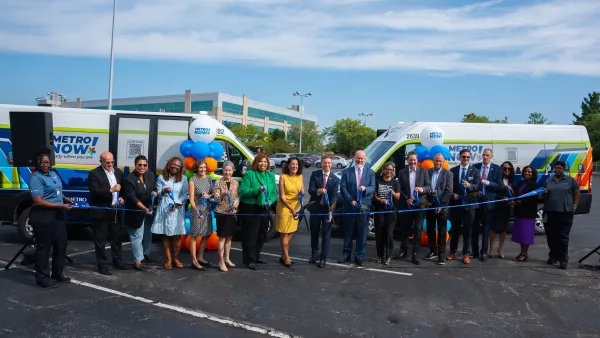
Three agencies expanding on-demand transit
Multiple states across America increasing access to flexible public transportation.

Planetizen Federal Action Tracker
A weekly monitor of how Trump’s orders and actions are impacting planners and planning in America.

Northwest rail fans eager for Sept. 30 debut of Amtrak’s Airo fleet
Get ready for that new train smell and more seats. But they won’t go faster or run more frequently on the Cascades route in Washington and Oregon.

Trump is considering data centers on 6 states' public land — some state officials say they had no idea
If the administration approves the proposed projects, data center and data center-related developments will cover 17,600 acres of public land.

After decades of planning, Sacramento gains new light rail station
Trains will arrive every 15 minutes during peak hours and every 30 minutes during non-peak hours.

Massive tunnel-boring machine breaks ground on Gateway Project
The Trump administration revoked funding for the project in October 2025, and then restored it earlier this year.

Airo trainsets begin service on Amtrak Cascades route
The trains feature panoramic windows, complementary wifi and over 300 seats per train set.

FREE Course: Walkable City 1: Why Walkability?
After describing his path towards focusing on walkability as the essence of good planning, Jeff Speck marches through his five principal reasons for making more walkable places.
Reinventing Malls: Planning Alchemy—Turning Gray Fields Into Gold
The course focuses on the opportunities and imperatives that shape reinvention of mall sites.

City of Thousand Oaks
City of Wisconsin Rapids
Harvard University Graduate School of Design
The Architects Foundation
University of Cincinnati Online
The Pocatello Development Authority
The Urban Renewal Agency of the City of Pocatello