A Switzerland-based design group is bringing back the geodesic dome in a big way with an aquaponic greenhouse that can be placed on just about any flat roof, Zak Stone reports.


For all the press it has received, urban farming is often portrayed as a practice consisting solely of elbow grease and some vacant land. And while it may not require any more than that at the bare minimum, promises of truly land-efficient urban food production come most often in the form of forward-thinking structures that are designed to make good use of limited space. Where, then, can grassroots and high design find common ground to grow on?
Enter the Globe / Hedron, by Zürich-based Conceptual Devices. The geodesic dome "would house an aquaponics system," Stone writes – "a mini-ecosystem in which plants clean the water where fish swim and fish waste fertilizes the plants – capable of feeding 16 people year-round. The unique structure of the dome... would support the weight of the fish tank, enabling installation on flat roofs without adapting the structure of the building."
"Panels on the dome's exterior would provide both shade and insulation, allowing the the structure to adapt to local environments, while the compact size and easy assembly would enable it to be shipped around the world."
Read the full story: A Geodesic Dome Promises Fish from the Sky

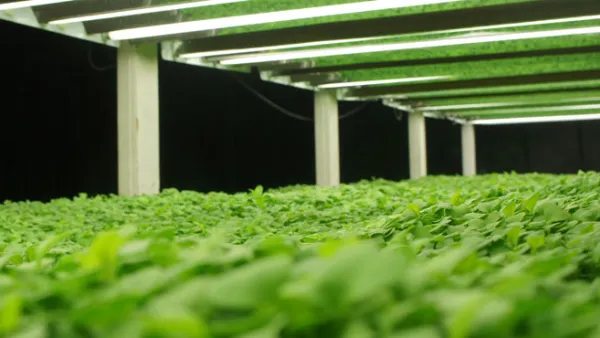
America's Largest Indoor Vertical Farm Opens in Chicago
Chicagoans sure take their urban agriculture seriously. While the city focuses on converting vacant land to farms in some of the city's struggling neighborhoods, entrepreneurs are doing the same indoors.
New York Becomes a Global Leader in...Farming?
Only a decade after the last family farm in the city closed, commercial agriculture is mining "the last slice of untapped real estate in the city" to reap a bounty of benefits - from locally grown basil and bok choy to lower greenhouse gas emissions.
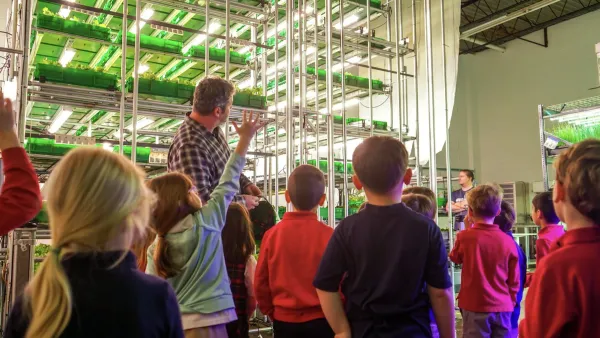
A Multimillion Dollar Virginia Company is Turning Empty Office Buildings Into Farms
Area 2 Farms envisions a world where 90% of the U.S. population lives within 10 miles of an indoor farm.

Planetizen Federal Action Tracker
A weekly monitor of how Trump’s orders and actions are impacting planners and planning in America.

Amtrak, CN end decades-long dispute with eight-year agreement
The new operating agreement establishes an updated framework for the companies to work together, including processes to resolve disputes.

Judges permit Denver to divert 77,000 acre feet from the Colorado River for reservoir expansion
Overuse and climate change have caused the Colorado River’s water levels to plummet.

South Chicago development proposal would 'upzone' neighborhoods to increase density
The South Chicago Land Use Framework plan also aims to promote pedestrian and transit-oriented developments.

Boston has spent millions making the Green Line more accessible — and there’s no end in sight
While the city has invested millions into expanding and adding platforms to the Green Line to make it more accessible, new train cars set to arrive next year will be too tall for disabled passengers to board without raising the current platforms.

Idaho may see an 18% drop in federal surface transit funding — the largest estimated cut in the US
Transit systems in rural communities are much more reliant on federal funding to provide their services.

FREE Course: Walkable City 1: Why Walkability?
After describing his path towards focusing on walkability as the essence of good planning, Jeff Speck marches through his five principal reasons for making more walkable places.
Reinventing Malls: Planning Alchemy—Turning Gray Fields Into Gold
The course focuses on the opportunities and imperatives that shape reinvention of mall sites.

City of Wisconsin Rapids
Harvard University Graduate School of Design
KFH Group Inc.
The Architects Foundation
University of Cincinnati Online
The Pocatello Development Authority
The Urban Renewal Agency of the City of Pocatello