John Metcalfe explores a new kind of hybrid vehicle that could revolutionize trucking and cut down air contaminants in one of the most polluted regions in the country.


New technologies unveiled at the annual Electric Vehicle Symposium last week have been making headlines, and not just for consumers. German tech giant Siemens presented a vision for electrified highways (or eHighways, for short) that could ease the reliance on diesel fuel for cargo trucks.
"The key word here is pantograph," Metcalfe writes. "That's the flexible doohickey that you see on the top of a streetcar connecting it to an electric wire. The idea is to work with truck manufacturers to develop a hybrid vehicle with a pantograph that couples with a power line running above the highway."
Siemens has created a mile-long prototype of its eHighway on an abandoned airstrip in Germany, and eventually hopes to pilot the technology on the I-710 in Southern California, feeding off the ports of Long Beach and Los Angeles.
"The electric highway would, with luck, reduce some of the foul air that currently makes the L.A. region the country's No. 1 city for ozone pollution and No. 3 in particle pollution, by the American Lung Association's ranking. Several key groups have expressed early interest in the project, including the Southern California Association of Governments, the South Coast Air Quality Management District, and Southern California Edison."
"When most people think of vehicle emissions, they assume cars do most of the damage," says Daryl Dulaney, infrastructure chief at Siemens, "but it's actually commercial trucks that are largely to blame."
Read the full story: Could Electric Truck Lanes Reduce L.A.'s Horrific Pollution?
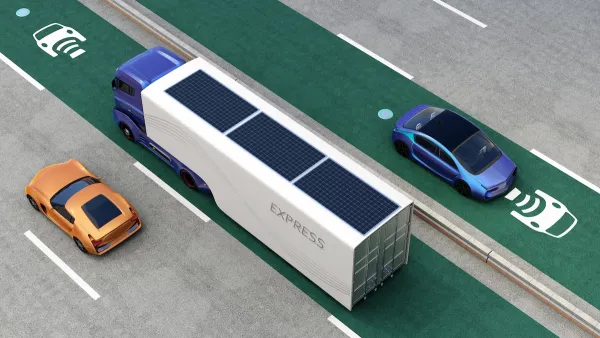
UCLA Will Build California’s First EV Charging Roadway
The ¾-mile segment will allow electric shuttles and buses to charge while driving.
L.A. County Expands Electric Vehicle Fleet to Combat Climate Change
Leading by example, the county is increasing its electric vehicle fleet to reduce greenhouse gas emissions and promote sustainability.
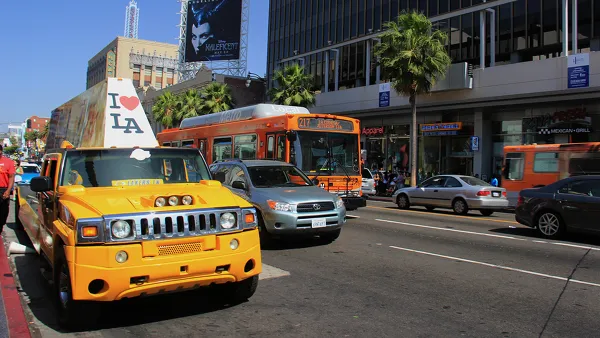
Can Los Angeles Join the Anti-Gas Station Movement?
A growing number of cities in California have prohibited the construction of new gas stations. Los Angeles could soon consider an ordinance to do the same—in a landmark move for the city some believe to be a symbol of car-dependent sprawl.

Planetizen Federal Action Tracker
A weekly monitor of how Trump’s orders and actions are impacting planners and planning in America.

Eastern Nebraska is running out of electricity
Data centers and electrification are straining eastern Nebraska’s grid, throttling economic development.

Study reveals best places in the U.S. for cycling, walking
New research from Streetlight Data examines bicycle and pedestrian miles per capita in the 100 largest U.S. cities by population.

DSA members accuse Mamdani of 'abandoning values' over housing redevelopment
New York City's mayor plans to replace about 2,000 units of public housing with private, mixed-income housing.

All sides of BRT debate unhappy with CDOT’s most recent move
The Colorado Department of Transportation is no longer considering center-running bus lanes for Colorado Boulevard.

Massachusetts bogs generate both power, and cranberries
Putting solar panels above farmland is one way Massachusetts is advancing toward its goal of net-zero carbon emissions by 2050.

FREE Course: Walkable City 1: Why Walkability?
After describing his path towards focusing on walkability as the essence of good planning, Jeff Speck marches through his five principal reasons for making more walkable places.
Reinventing Malls: Planning Alchemy—Turning Gray Fields Into Gold
The course focuses on the opportunities and imperatives that shape reinvention of mall sites.

City of Rosemead
Rutgers University, Edward J. Bloustein School of Planning and Public Policy
One Hundred Miles
University of Michigan School for Environment and Sustainability (SEAS)
Hunter College, City University of New York (CUNY)
The Architects Foundation
City of Cambridge
The Pocatello Development Authority
The Urban Renewal Agency of the City of Pocatello