Christopher Hawthorne begins a series exploring the ways in which L.A. is utilizing its boulevards to try on "a post-suburban identity for the first time", with a look at Atlantic Boulevard, a major north-south spine.


Hawthorne sees the dramatic evolution of L.A.'s boulevards, as they accomodate multiple modes of transit and increasingly become places to live, as the epicenter of the city's efforts to re-embrace the public realm. In the first in a series of multimedia articles on the topic, he explores Atlantic Boulevard, a major north-south route from the San Gabriel Valley to Long Beach.
"The changes along Atlantic are emblematic of the way urban planners,
architects, shopkeepers and neighborhood activists are remaking the
boulevards of Southern California, reversing decades of neglect."
"The boulevard, in fact, is where the Los Angeles of the immediate
future is taking shape. No longer a mere corridor to move cars, it is
where L.A. is trying on a fully post-suburban identity for the first
time, building denser residential neighborhoods and adding new amenities
for cyclists and pedestrians."
"In the process, the city is beginning to shed its reputation as a
place where the automobile is king - or at least where its reign goes
unchallenged. Cities across the U.S. followed L.A.'s car-crazy lead in
the postwar era. This time around we might provide a more enlightened
example: how to retrofit a massive region for a future that is less
auto-centric."
Read the full story: Atlantic on the move
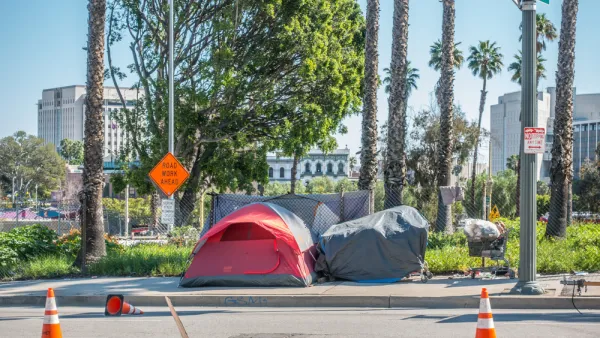
Los Angeles Could Broaden Homeless Sleeping Prohibition to a Quarter of the City
There won't be many places left to sleep for the massive population of homeless living in the city of Los Angeles.
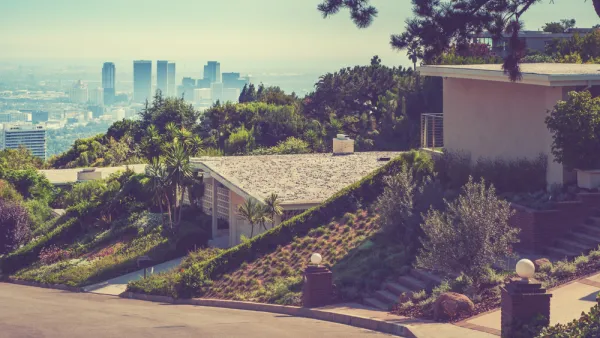
Los Angeles: Focus on Urban Design (Not Just Urban Planning)
By embracing timeless principles of urban placemaking, we can create walkable transit villages and make room for housing at every socioeconomic level. First we have to re-invigorate high quality urban design.
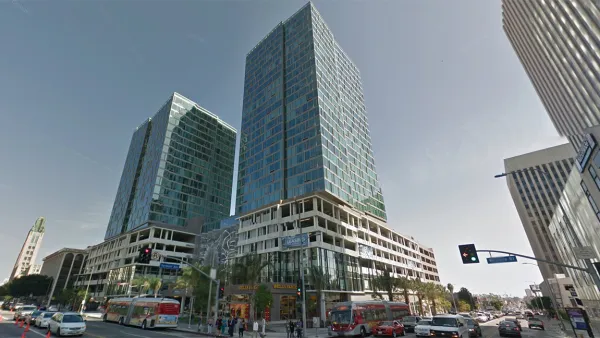
Los Angeles Planners Have Had It Up to Here With Parking Podiums
Above-grade parking garages, also called parking podiums, have become a standard typology across Los Angeles. From Koreatown to Downtown, new residential buildings are separated from the street by several floors of space devoted to parking.

Planetizen Federal Action Tracker
A weekly monitor of how Trump’s orders and actions are impacting planners and planning in America.

California plans to bury El Niño’s downpour
If the state plays its cards right, it may be able to store a billion acre-feet of El Niño’s water in aquifers.

Desperate measures: Advocates weigh draining Lake Powell to fill Colorado River
Draining the reservoir could reduce evaporation losses by a couple hundred thousand acre-feet.

Housing is the top priority of Seattle’s sole new councilmember
Jenks campaigned on building 1,000 new units of affordable housing.

New tax cuts may slash $1.5 billion in funding for Miami transit, public parks
Amendment 3 will save Miami-Dade homeowners $2,700 in 2028.

Arizona, Wisconsin, Pennsylvania hope to finally advance climate goals post-midterms
The three states have spent years under Republican or divided control.

FREE Course: Walkable City 1: Why Walkability?
After describing his path towards focusing on walkability as the essence of good planning, Jeff Speck marches through his five principal reasons for making more walkable places.
Reinventing Malls: Planning Alchemy—Turning Gray Fields Into Gold
The course focuses on the opportunities and imperatives that shape reinvention of mall sites.

City of Rosemead
Rutgers University, Edward J. Bloustein School of Planning and Public Policy
One Hundred Miles
University of Michigan School for Environment and Sustainability (SEAS)
Hunter College, City University of New York (CUNY)
The Architects Foundation
City of Cambridge
Montrose County
The Pocatello Development Authority