Launched this week, Houston's first bike share program is seen as a significant step in helping to dispel "Houston's national reputation as an uncongenial, sprawling metropolis," reports Allan Turner.


While not nearly as ambitious as the programs scheduled to be unveiled in the next year in Los Angeles or New York, Houston's federally funded system is expected to bring more than 200 bikes to areas between downtown and the Texas Medical Center by year's end. For Mayor Annise Parker, "an occasional bicyclist," the centrally-focused program, "may help familiarize residents with downtown, an area she said many still consider 'foreign territory.'"
While limited in its initial scope, the program signals a key cultural shift in the way Houstonians think about their built environment.
"'People want to live, work, play and eat close to one another and not be in their car as much,' city sustainability director Laura Spanjian said, citing a recent Rice University study that found most respondents wanted to live in compact, walkable communities. 'The love affair with the car is finally over, and providing alternatives to help people get around in the urban environment will be increasingly important.'"
Read the full story: Houston saddles up for downtown bike share program
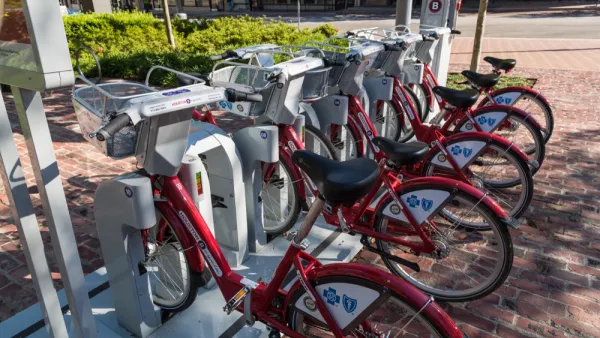
Houston Metro Abandons Bike Share in Favor of On-Demand Microtransit
The agency failed to include funding for bike share in its 2025 budget proposal.
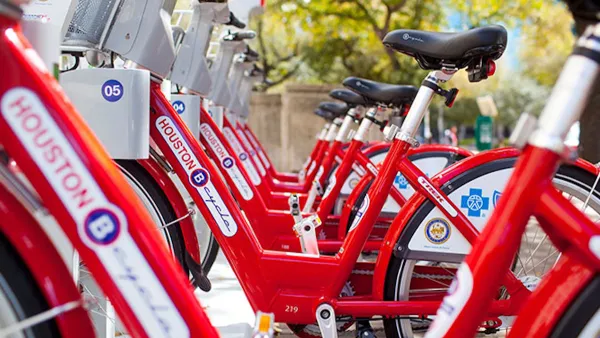
Houston Will Be Largest US City Without Bike Share
The city’s bike share system will cease operations at the end of June.
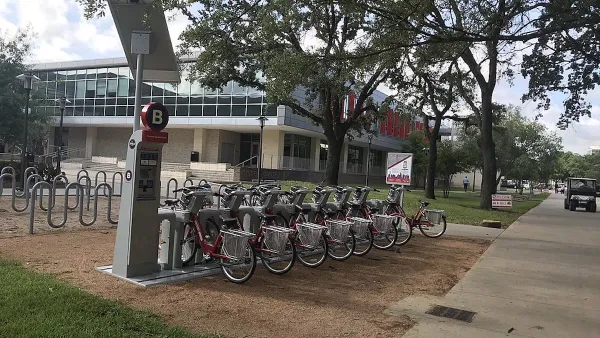
From Zero to Two: Houston’s Bike Share Saga Continues
The city is now proposing supporting BCycle as well as launching a new, complementary system.

Planetizen Federal Action Tracker
A weekly monitor of how Trump’s orders and actions are impacting planners and planning in America.

Eastern Nebraska is running out of electricity
Data centers and electrification are straining eastern Nebraska’s grid, throttling economic development.

Study reveals best places in the U.S. for cycling, walking
New research from Streetlight Data examines bicycle and pedestrian miles per capita in the 100 largest U.S. cities by population.

DSA members accuse Mamdani of 'abandoning values' over housing redevelopment
New York City's mayor plans to replace about 2,000 units of public housing with private, mixed-income housing.

All sides of BRT debate unhappy with CDOT’s most recent move
The Colorado Department of Transportation is no longer considering center-running bus lanes for Colorado Boulevard.

Massachusetts bogs generate both power, and cranberries
Putting solar panels above farmland is one way Massachusetts is advancing toward its goal of net-zero carbon emissions by 2050.

FREE Course: Walkable City 1: Why Walkability?
After describing his path towards focusing on walkability as the essence of good planning, Jeff Speck marches through his five principal reasons for making more walkable places.
Reinventing Malls: Planning Alchemy—Turning Gray Fields Into Gold
The course focuses on the opportunities and imperatives that shape reinvention of mall sites.

City of Rosemead
Rutgers University, Edward J. Bloustein School of Planning and Public Policy
One Hundred Miles
University of Michigan School for Environment and Sustainability (SEAS)
Hunter College, City University of New York (CUNY)
The Architects Foundation
City of Cambridge
The Pocatello Development Authority
The Urban Renewal Agency of the City of Pocatello