Meghan Stromberg reports on the opening keynote from this year's annual APA national conference, taking place in Los Angeles through April 17th. Dr. Andrew Weaver spoke about the disconnect between climate change science and public perception.


One of the lead authors of the UN Intergovernmental Panel on Climate Change's landmark report Climate Change 2007: The Physical Science Basis, Dr. Weaver spoke about the overwhelming scientific consensus behind the human impacts on climate change and divergent public perception of the problem and its causes.
He attributes this disconnect to both "how scientists communicate - including using jargon and failing to present complex issues in a way that nonscientists can understand - and how the media present these issues," writes Stromberg.
"The media, he said, employ sensationalist headlines and cite experts who lack true scientific credentials. Most egregiously, the media distort the facts in the name of providing the appearance of balanced reporting. In doing so, they give disproportionate time and voice to the small group of people who doubt the existence of climate change or the evidence that increased greenhouse gas emissions are the cause."
While the current commitments of the world's nations for reducing emissions by 2050 appear inadequate to head off the 2 degree Celsius threshold for significant impacts, Dr. Weaver was optimistic about the longer-range opportunity to create entirely de-carbonized societies through technological innovation, and implored planners to build the infrastructure to facilitate such a transformation.
Read the full story: Opening Keynote: Communicating Climate Change

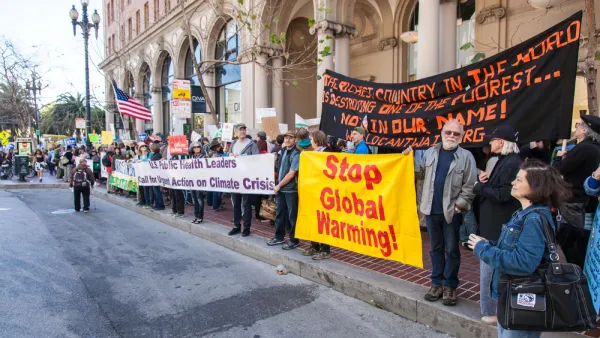
Searching for Clearer Climate Change Messaging
Although clear climate communication is more important than ever, many people find even basic terminology about climate change confusing, research shows.

Land Use the Subject of Latest IPCC Report
Not urban land use, but in the literal sense: land used to produce food, graze livestock, supply drinking water, grow trees, and sequester carbon. As the climate warms and the population grows, crop yields will decrease and land will be degraded.
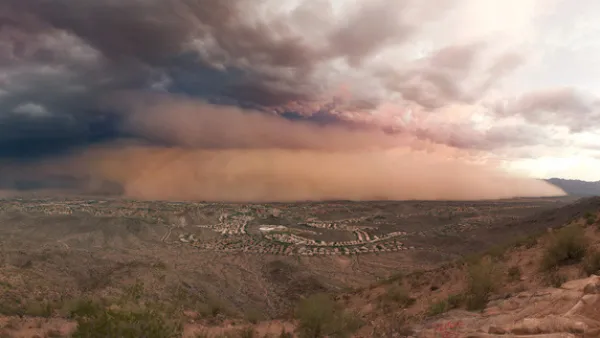
Carbon Taxes and Climate Change Are Focus of Nobel Prize for Economics
The Nobel Prize was issued the same day as a landmark report by the IPCC predicting dire consequences if emissions aren't reduced. That's what William D. Nordhaus of Yale University has devoted his career to addressing.

Planetizen Federal Action Tracker
A weekly monitor of how Trump’s orders and actions are impacting planners and planning in America.

Amtrak, CN end decades-long dispute with eight-year agreement
The new operating agreement establishes an updated framework for the companies to work together, including processes to resolve disputes.

Judges permit Denver to divert 77,000 acre feet from the Colorado River for reservoir expansion
Overuse and climate change have caused the Colorado River’s water levels to plummet.

Atlanta City Council unanimously backs $3.5 billion Beltline light rail project
The resolution was drafted after Atlanta Mayor Andre Dickens pulled support for the Atlanta Streetcar extension last year.

SEPTA to bring nearby frequent transit to over 1 million new riders as part of decade-long plan
The agency's Accelerate plan will also bring frequent transit to twice the amount of jobs that are currently located near it.

NYC plants over 18,000 trees, the most new foliage in a decade
Many of the trees were planted in communities vulnerable to extreme heat.

FREE Course: Walkable City 1: Why Walkability?
After describing his path towards focusing on walkability as the essence of good planning, Jeff Speck marches through his five principal reasons for making more walkable places.
Reinventing Malls: Planning Alchemy—Turning Gray Fields Into Gold
The course focuses on the opportunities and imperatives that shape reinvention of mall sites.

City of Thousand Oaks
City of Wisconsin Rapids
Harvard University Graduate School of Design
The Architects Foundation
University of Cincinnati Online
The Pocatello Development Authority
The Urban Renewal Agency of the City of Pocatello