Eric Moskowitz reports on the results of a recent Boston Globe pool which shows Massachusetts voters support a publicly financed bailout of the state's cash-strapped transit agency.


The results of the survey, which showed the strongest support for a bailout in the areas in and around Boston, surprised pollsters and heartened those seeking to rescue what Moskowitz describes as "the nation's most indebted transit agency," and a highway system "so revenue-starved it must borrow to pay for routine upkeep."
In the face of recent proposals to make up a $160 million deficit for the upcoming fiscal year through fare hikes and deep service cuts, the survey shows a general recognition for the importance of the transportation system to residents and the regional economy.
According to Stephanie Pollack, associate director of Northeastern University's Dukakis Center for Urban and Regional Policy, the poll results show that the, "conversation that's been unfolding over the last few months has really made [many] more people aware of how important the MBTA is... Even people who don't necessarily use it themselves have heard and read a lot about how important it is to other people and to the economy and employers.''
In an echo of the communication problem plaguing transportation financing across the country, Moskowitz points out that, "Analysts said work remains to explain to the public that fares alone do not cover the cost of any transit system, and that the state's gas taxes and tolls - rarely raised because of political pressure - fall short of providing enough money for road paving and striping, let alone major bridge and highway repairs."
Read the full story: 40% in survey support a state bailout for MBTA
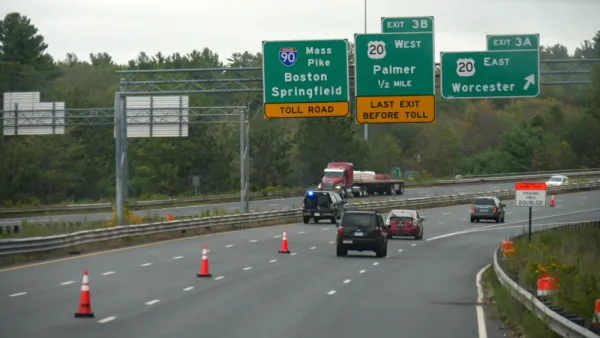
Local Leaders Press Massachusetts for New Sources of Transportation Funding
Three separate coalitions of local mayors, each from different corners of Eastern Massachusetts, want to the commonwealth to prioritize transportation funding. Some even called for a 15-cent increase to the gas tax.
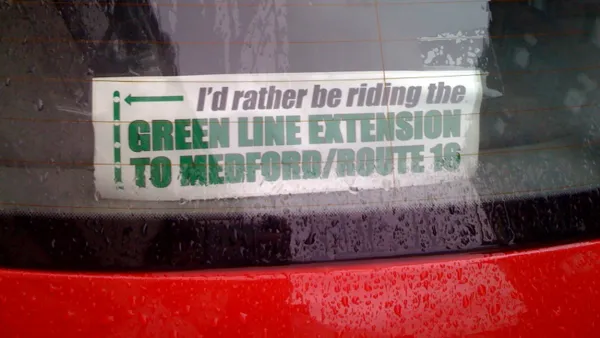
MBTA's Green Line Extension Moving Forward Again
A revised plan to extend the MBTA's Green Line light rail line into Somerville and Medford required approval from the state (approved last May) and the Federal Transit Authority (approved this week).

New Look MBTA Trains Debut in Boston
Boston residents got their first look earlier this week at the new trains that will grace the T tracks in 2019.

Planetizen Federal Action Tracker
A weekly monitor of how Trump’s orders and actions are impacting planners and planning in America.

California plans to bury El Niño’s downpour
If the state plays its cards right, it may be able to store a billion acre-feet of El Niño’s water in aquifers.

Desperate measures: Advocates weigh draining Lake Powell to fill Colorado River
Draining the reservoir could reduce evaporation losses by a couple hundred thousand acre-feet.

Los Angeles just elected an urban planner as its mayor
Transportation analysts are optimistic that Raman will be more aggressive in addressing transit issues than Bass.

Mamdani’s pied-à-terre tax survives legal challenge
A panel of judges found that the plaintiffs failed to demonstrate injury as a result of New York City's implementation of the tax.

Eastern Nebraska is running out of electricity
Data centers and electrification are straining eastern Nebraska’s grid, throttling economic development.

FREE Course: Walkable City 1: Why Walkability?
After describing his path towards focusing on walkability as the essence of good planning, Jeff Speck marches through his five principal reasons for making more walkable places.
Reinventing Malls: Planning Alchemy—Turning Gray Fields Into Gold
The course focuses on the opportunities and imperatives that shape reinvention of mall sites.

City of Rosemead
Rutgers University, Edward J. Bloustein School of Planning and Public Policy
One Hundred Miles
University of Michigan School for Environment and Sustainability (SEAS)
Hunter College, City University of New York (CUNY)
The Architects Foundation
City of Cambridge
Montrose County
The Pocatello Development Authority