Sarah Wheaton and Richard A. Oppel Jr. report on a new line of attack against the urban favoring economic policies of his own party, being utilized by Republican presidential candidate Rick Santorum in an effort to motivate his followers.


Highlighting a divide he sees between urban (Democratic) and rural (Republican) America, Santorum has taken to attacking Republican tax plans that he says will benefit "higher-income individuals who live in those blue areas [around big cities] mostly."
According to Wheaton and Oppel, "[i]n highlighting who would benefit from competing Republican tax proposals, Mr. Santorum seemed to be using urban-rural rivalry as a way to suggest that Mitt Romney, one of his opponents, was the candidate of more liberal city dwellers and that he was the candidate of more conservative rural residents, though polls show that Mr. Romney tends to do well in suburban areas."
By emphasizing the geographic divide of their basis of support, Santorum is suggesting a somewhat counter-intuitive argument that Romney's popularity in traditionally democratic areas makes him less likely to win a general election. "If we're going to win this election, we have to have a candidate who is going to energize our base, get them excited," said Santorum.
Read the full story: Santorum Takes On Urban America

Energy Department Resumes Loan Program with Hydrogen Storage
The Energy Department's loan office, known for a bad loan to the solar panel startup Solyndra in 2011, will loan $504 million to a company that will use renewable energy to create 'green hydrogen' and store it in salt caverns in Utah.
The Big Taboo of the Senate's Bipartisan Infrastructure Proposal
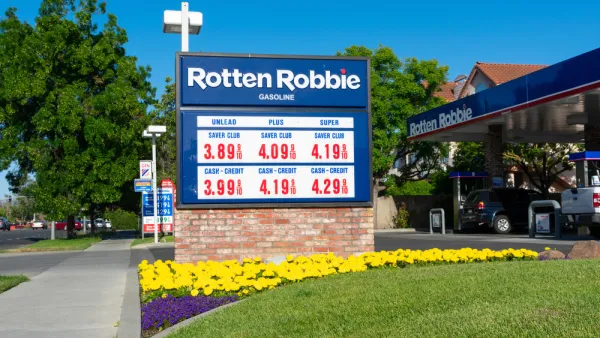
Ten bipartisan senators have proposed a nearly $1 trillion infrastructure deal with no new taxes, but it does include indexing the current gas tax of 18.4 cents per gallon, unchanged in 28 years, to inflation, thus potentially increasing gas prices.
Gubernatorial Elections Have Environmental Consequences
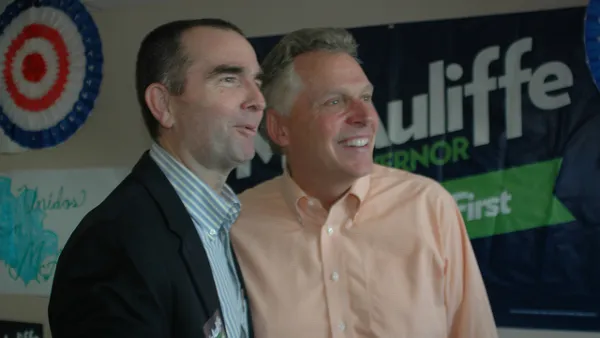
A movement initiated by Gov. Terry McAuliffe (D-Va.) to join the East Coast carbon cap-and-trade program has accelerated with the election of his Democratic lieutenant governor, Ralph Northam, as governor. Similar news is expected from New Jersey.

Planetizen Federal Action Tracker
A weekly monitor of how Trump’s orders and actions are impacting planners and planning in America.

Eastern Nebraska is running out of electricity
Data centers and electrification are straining eastern Nebraska’s grid, throttling economic development.

Move over, LA: St. Louis gears up for Olympics, invests millions in downtown redevelopment
The Missouri city will host the 2028 Olympic soccer group stage and knockout matches.

Dallas releases zoning code overhaul to officials
The drafted overhaul is over 400 pages long.

NYC renovations for dangerous, ‘mercilessly crammed’ street delayed until 2027
Construction was supposed to begin this fall.

San Diego’s Midway Rising project gets greenlight from city council
The project looks to become the largest affordable housing development in California's history.

FREE Course: Walkable City 1: Why Walkability?
After describing his path towards focusing on walkability as the essence of good planning, Jeff Speck marches through his five principal reasons for making more walkable places.
Reinventing Malls: Planning Alchemy—Turning Gray Fields Into Gold
The course focuses on the opportunities and imperatives that shape reinvention of mall sites.

City of Rosemead
Rutgers University, Edward J. Bloustein School of Planning and Public Policy
One Hundred Miles
University of Michigan School for Environment and Sustainability (SEAS)
Hunter College, City University of New York (CUNY)
The Architects Foundation
City of Cambridge
The Pocatello Development Authority
The Urban Renewal Agency of the City of Pocatello