Kai Laursen argues for satellite cities as a promising alternative to accommodate population growth, while preserving open space and farmland, and minimizing urban sprawl.


Laursen sees infill development alone as inadequate to meet the world's long-term need to house 9 billion individuals by 2050.
Rather, he sees a solution in developing satellite cities, which he defines as "planned cities...surrounded by greenbelt areas and..connected to the greater metropolitan area by an efficient rail system...[and] differ[ing] from suburbs, subdivisions, and bedroom communities in that they have municipal governments distinct from that of the core metropolis and employment bases sufficient to support their resident populations."
In his utopian vision, Laursen imagines a "satellite solar city" that would be carbon neutral and car-free, and utilize seemingly every novel energy and transportation concept currently in circulation, including personal rapid transit (PRT).
Read the full story: Solar Satellites


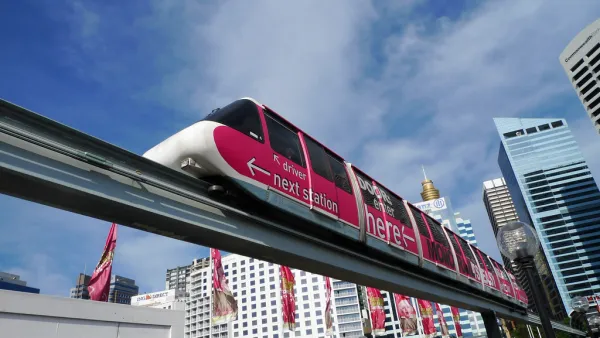
Elon Musk's 'Personal Rapid Transit' Plans Panned By Critics
The "Loop" is the latest manifestation of Elon Musk's transportation fantasies, offering "personal rapid transit" to and from anywhere in Los Angeles without any congestion or cost.
All the Many Solutions to Atlanta's Traffic Gridlock
Atlanta Magazine has gathered together five of the often discussed, but never implemented, plans to move people effortlessly around Atlanta. And they've thrown in one canard to see if you've been paying attention.
Hyperloop One Hails its 'Kitty Hawk' Moment in the Nevada Desert
PBS kicks off its new science and technology series with a look at just what happened in the desert with MIT's Hyperloop team. Science correspondent Miles O'Brien likens the week's events more to the "glider moment" preceding Kitty Hawk.

Planetizen Federal Action Tracker
A weekly monitor of how Trump’s orders and actions are impacting planners and planning in America.

Amtrak, CN end decades-long dispute with eight-year agreement
The new operating agreement establishes an updated framework for the companies to work together, including processes to resolve disputes.

Judges permit Denver to divert 77,000 acre feet from the Colorado River for reservoir expansion
Overuse and climate change have caused the Colorado River’s water levels to plummet.

NYC DOT wants faster, more permanent street upgrades
The city is examining ways to build more concrete infrastructure without getting entangled in 'decades-long' projects.

'Something we’ve never seen before:' rising utility rates could strain city finances nationwide
Data centers, climate change and other factors have caused utility rates in the United States to increase by 38% since 2020.

Trump to overrule local leaders, lease millions of acres of America’s Pacific Island territories’ seafloors to mining companies
International law says that the Indigenous people of America’s territories have a right to prior and informed consent regarding projects that impact their countries.

FREE Course: Walkable City 1: Why Walkability?
After describing his path towards focusing on walkability as the essence of good planning, Jeff Speck marches through his five principal reasons for making more walkable places.
Reinventing Malls: Planning Alchemy—Turning Gray Fields Into Gold
The course focuses on the opportunities and imperatives that shape reinvention of mall sites.

Harvard University Graduate School of Design
KFH Group Inc.
Greater Baltimore Committee
The Architects Foundation
University of Cincinnati Online
The Pocatello Development Authority
The Urban Renewal Agency of the City of Pocatello