After a drawn-out saga, Tom Stoelker reports on the settlement reached last week over the fate of the Manufacturers Hanover Trust building in Manhattan.


According to Stoelker, Vornado Reality and preservationists have finally reached an agreement for how to preserve, and redevelop, key elements of the building designed by Gordon Bunshaft for Skidmore Owings and Merrill (SOM) in 1954.
The primary issue of contention between the two sides was how to protect the interior elements of the former bank building as it's converted to retail uses. Victories for preservationists include the expansion of the landmarking to include the interior of the former vault space and the reinstallation of two Harry Bertoia sculptures.
Not all of preservationists' concerns were addressed in the agreement, however. "Several other contentious elements remain. The escalators that were once viewed in profile from Fifth Avenue, now run perpendicular to the avenue, and two doors were inserted onto the Fifth Avenue facade," noted Stoelker.
Read the full story: Glass Half Full

MTA gives itself 30 days to transform pit into basketball court
The site has been under construction since 2022; the city originally estimated it would finish the court in 2024.
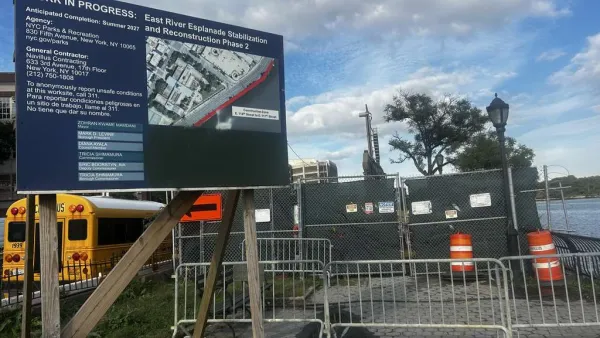
Ballooning costs delay NYC green space restoration after six years of planning
“There’s a stark inequity in how the city prioritizes infrastructure projects across different Manhattan neighborhoods," said Maria Kessler, executive director for Friends of the East River Esplanade. “Why is this neighborhood the last and unserved?”
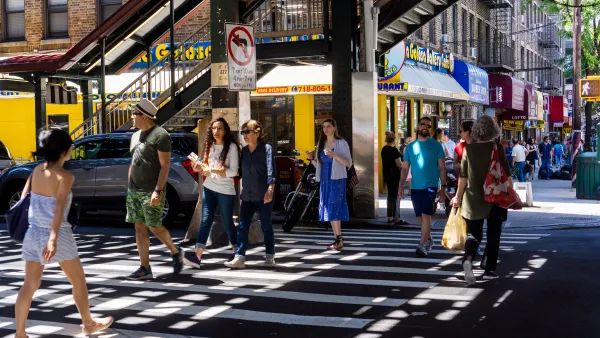
NYC needs 700,000 new homes to resolve housing crisis, report states
The report gave every neighborhood a non-binding development target.

Planetizen Federal Action Tracker
A weekly monitor of how Trump’s orders and actions are impacting planners and planning in America.

California plans to bury El Niño’s downpour
If the state plays its cards right, it may be able to store a billion acre-feet of El Niño’s water in aquifers.

Desperate measures: Advocates weigh draining Lake Powell to fill Colorado River
Draining the reservoir could reduce evaporation losses by a couple hundred thousand acre-feet.

Los Angeles just elected an urban planner as its mayor
Transportation analysts are optimistic that Raman will be more aggressive in addressing transit issues than Bass.

Mamdani’s pied-à-terre tax survives legal challenge
A panel of judges found that the plaintiffs failed to demonstrate injury as a result of New York City's implementation of the tax.

Eastern Nebraska is running out of electricity
Data centers and electrification are straining eastern Nebraska’s grid, throttling economic development.

FREE Course: Walkable City 1: Why Walkability?
After describing his path towards focusing on walkability as the essence of good planning, Jeff Speck marches through his five principal reasons for making more walkable places.
Reinventing Malls: Planning Alchemy—Turning Gray Fields Into Gold
The course focuses on the opportunities and imperatives that shape reinvention of mall sites.

City of Rosemead
Rutgers University, Edward J. Bloustein School of Planning and Public Policy
One Hundred Miles
University of Michigan School for Environment and Sustainability (SEAS)
Hunter College, City University of New York (CUNY)
The Architects Foundation
City of Cambridge
Montrose County
The Pocatello Development Authority