Jon Bruner profiles Los Angeles Department of Transportation Engineer Edward Yu, and the ATSAC system run by Yu and his team, which controls the timing of traffic lights at each of the city's 4,114 intersections.


To judge by the level of congestion that the average driver confronts every day on the streets of Los Angeles, some might argue that Yu and ATSAC aren't doing a good enough job. But the Automated Traffic Surveillance & Control system (ATSAC), is adaptive, and as it builds a rich database of historical traffic statistics and patterns it is learning, so give it some time.
ATSAC was first implemented in 1984, the first such system in the country, and it proved itself quickly, despite what rush hour horror stories might tell you. "Repeated studies since the 1990s have found that travel times fall by 15% near connected signals and motorists make 20% to 30% fewer stops, massive improvements for a cost of about $150,000 per intersection. "
Read the full story: 4,114 Stoplights in Los Angeles and the Intricate Network that Keeps Traffic Moving

New Bus Priority Lane Under Construction in Los Angeles
La Brea Avenue will soon gain a new bus priority lane, with plans for more to come still gathering community feedback.

Report: How L.A.'s Transportation System Fails Women
According to an LADOT study, the city's women face disproportionate barriers in accessing safe, efficient transportation.
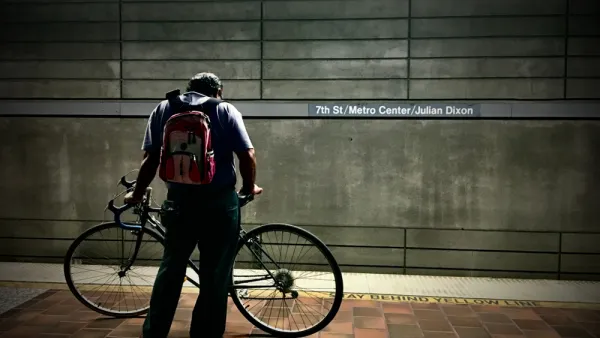
Scooter Revenue, Empty Streets Allow for Quick Construction of Bike Lane in L.A.
A busy corridor, popular with bike and scooter riders, is gaining a new protected bike lane in Los Angeles.

Desperate measures: Advocates weigh draining Lake Powell to fill Colorado River
Draining the reservoir could reduce evaporation losses by a couple hundred thousand acre-feet.

Eastern Nebraska is running out of electricity
Data centers and electrification are straining eastern Nebraska’s grid, throttling economic development.

Malls are becoming the midtowns of the future
Mall and office park redevelopments are a generational opportunity to create new nodes of urbanity.

NYC breaks ground on anti-flooding infrastructure project
New York City's new system will reduce stormwater flows to local sewers by 90%.

One Kentucky town’s secret to affordable housing
The Smoketown Community Land Trust has already built seven affordable homes for community members.

Houston gains petal-shaped cooling infrastructure to make streets more ‘delightful’
The city has installed the pavilions along 15 blocks in Houston.

FREE Course: Walkable City 1: Why Walkability?
After describing his path towards focusing on walkability as the essence of good planning, Jeff Speck marches through his five principal reasons for making more walkable places.
Reinventing Malls: Planning Alchemy—Turning Gray Fields Into Gold
The course focuses on the opportunities and imperatives that shape reinvention of mall sites.

City of Rosemead
Rutgers University, Edward J. Bloustein School of Planning and Public Policy
One Hundred Miles
University of Michigan School for Environment and Sustainability (SEAS)
Hunter College, City University of New York (CUNY)
The Architects Foundation
City of Cambridge
Montrose County
The Pocatello Development Authority