Abu Dhabi today reaffirmed its commitment to completing the long-delayed project to build a $27 billion cultural and tourism project known as Saadiyat Island.


As Anthony Shadid reports in The New York Times, a veil of secrecy had hung over the future of the ambitious project in light of protests prompted by workers' conditions, fears of a financial bubble like the one that hit neighboring Dubai, and qualms over the overall vision for the project.
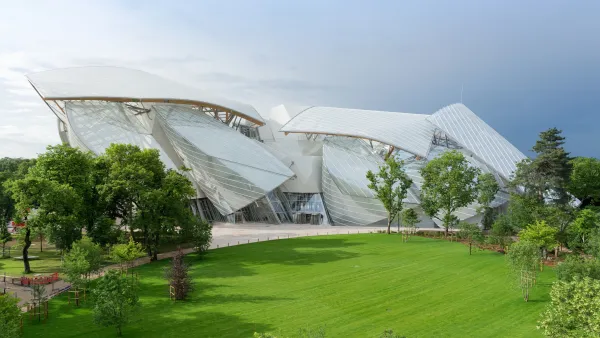
The project will include an architectural petting zoo of sorts featuring a branch of the Guggenheim museum designed by Frank Gehry, a branch of the Louvre designed by Jean Nouvel, and a national museum by Lord Norman Foster, which are now scheduled to be completed by 2017.
"These days, with something of a chip on its shoulder, Abu Dhabi appears determined to eclipse Dubai, its sister city, still reeling from the crash that began in 2008. The 10-square mile Saadiyat Island is one of the centerpieces of that Pharaonic vision, the museums joining a performing arts center designed by Zaha Hadid and a maritime museum planned by Tadao Ando."
Read the full story: An Ambitious Arab Capital Reaffirms Its Grand Cultural Vision

Op-Ed: Starchitecture Fails the Future
An addiction to spectacle and fad, says Peter Buchanan, has set architecture adrift in a sea of meaningless forms. And real design problems go ignored.
Buildings Gone Bad: 2014's Worst Architecture
The designs of architecture's most famous practitioners inspire the most public forms of attention and criticism. A recent column in Slate doesn't shy away from the latter.
The Parking Garage Gets Its Turn in the Architectural Spotlight
The gaze of the world's starchitects has turned lovingly towards the lowly parking garage. New projects by Zaha Hadid, Herzog & de Meuron, Frank Gehry, and Enrique Norten in Miami give a makeover to the Cinderella of structures.

Planetizen Federal Action Tracker
A weekly monitor of how Trump’s orders and actions are impacting planners and planning in America.

Amtrak, CN end decades-long dispute with eight-year agreement
The new operating agreement establishes an updated framework for the companies to work together, including processes to resolve disputes.

Judges permit Denver to divert 77,000 acre feet from the Colorado River for reservoir expansion
Overuse and climate change have caused the Colorado River’s water levels to plummet.

Boston has spent millions making the Green Line more accessible — and there’s no end in sight
While the city has invested millions into expanding and adding platforms to the Green Line to make it more accessible, new train cars set to arrive next year will be too tall for disabled passengers to board without raising the current platforms.

Idaho may see an 18% drop in federal surface transit funding — the largest estimated cut in the US
Transit systems in rural communities are much more reliant on federal funding to provide their services.

How ‘post-disaster gentrification’ alters neighborhoods after natural calamities
After hurricanes, fires or other calamities, the original residents of a community are often replaced by younger, wealthier residents.

FREE Course: Walkable City 1: Why Walkability?
After describing his path towards focusing on walkability as the essence of good planning, Jeff Speck marches through his five principal reasons for making more walkable places.
Reinventing Malls: Planning Alchemy—Turning Gray Fields Into Gold
The course focuses on the opportunities and imperatives that shape reinvention of mall sites.

City of Wisconsin Rapids
Harvard University Graduate School of Design
KFH Group Inc.
The Architects Foundation
University of Cincinnati Online
The Pocatello Development Authority
The Urban Renewal Agency of the City of Pocatello