Urban Omnibus declares the visionary work of the Speculation Studio at Columbia University an overdue evolution in architectural education.


In an interview with Laurie Hawkinson, Director of the Advanced Studios at Columbia's Graduate School of Architecture Planning and Preservation (GSAPP), Urban Omnibus explores the genesis, evolution, and products of the Speculation Studio, a collaboration of architecture and real estate students that created a radical proposal (dubbed LoLo, as in Lower Lower Manhattan) to connect the Financial District to Governors Island through a land bridge made of landfill, replete with a new mixed-use, high-rise, green infrastructure community.
"The boldness of the schemes and the cogency of the accompanying financial analysis explode the myth that considering financial implications in a student design process will constrain creativity and innovation."
For Hawkinson, "the most powerful aspect of the project is the way they created a new zoning protocol that takes into account energy and rising water levels to make a responsive system. In other words, instead of just caring about the setbacks and the shadows on the streets and things like that, they were calculating energy points people would get for acknowledging solar orientation or surface area."
Read the full story: Studio Report | The Speculation Studio: Governors Island, The Sixth Borough?
Proposal Dreams of New York Development Connecting Island to Mainland
The Center for Urban Real Estate unveiled a proposal to connect Lower Manhattan and Governors Island with landfill to spur development in the area. The connection would generate $16.7 billion of revenue for the city, the center estimates.
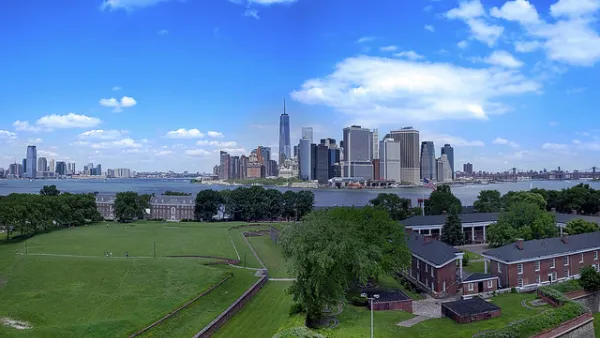
Finalists Selected for Governors Island Climate Research Center
Four teams will submit detailed proposals for a new climate research and education center on New York's Governors Island.
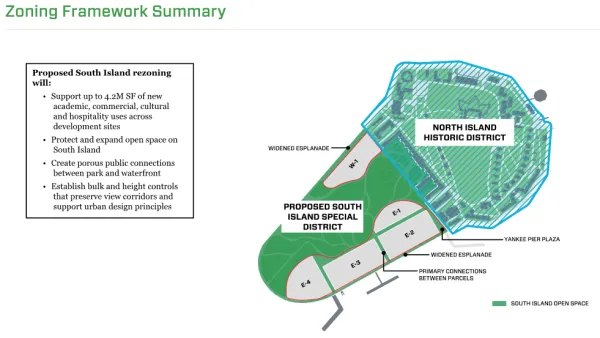
Rezoning for Governors Island Approved
A mix of new development focused on future needs and new tools for preservation are included in the rezoning package for the south end of Governors Island approved by the New York City Council in May.

Planetizen Federal Action Tracker
A weekly monitor of how Trump’s orders and actions are impacting planners and planning in America.

Eastern Nebraska is running out of electricity
Data centers and electrification are straining eastern Nebraska’s grid, throttling economic development.

Study reveals best places in the U.S. for cycling, walking
New research from Streetlight Data examines bicycle and pedestrian miles per capita in the 100 largest U.S. cities by population.

DSA members accuse Mamdani of 'abandoning values' over housing redevelopment
New York City's mayor plans to replace about 2,000 units of public housing with private, mixed-income housing.

All sides of BRT debate unhappy with CDOT’s most recent move
The Colorado Department of Transportation is no longer considering center-running bus lanes for Colorado Boulevard.

Massachusetts bogs generate both power, and cranberries
Putting solar panels above farmland is one way Massachusetts is advancing toward its goal of net-zero carbon emissions by 2050.

FREE Course: Walkable City 1: Why Walkability?
After describing his path towards focusing on walkability as the essence of good planning, Jeff Speck marches through his five principal reasons for making more walkable places.
Reinventing Malls: Planning Alchemy—Turning Gray Fields Into Gold
The course focuses on the opportunities and imperatives that shape reinvention of mall sites.

City of Rosemead
Rutgers University, Edward J. Bloustein School of Planning and Public Policy
One Hundred Miles
University of Michigan School for Environment and Sustainability (SEAS)
Hunter College, City University of New York (CUNY)
The Architects Foundation
City of Cambridge
The Pocatello Development Authority
The Urban Renewal Agency of the City of Pocatello