Long Beach is leading California's bicycle revolution in many ways, perhaps most creatively in establishing bike-friendly shopping districts.


Author Mark Hertsgaard, explains why Minneapolis and Portland could learn a lesson from a part of the country usually associated with the automobile. Led by Mayor Bob Foster, who tries to bike 100 miles a week, and backed by state and federal grants, the city has installed 130 miles of bike trails, built protected bike lanes, created bike boulevards, and installed 1,200 new bike racks.
However, as Hertsgaard points out, "Perhaps most innovative has been the city's effort to establish bike-friendly shopping districts -- the first in the country, officials say -- engaging local merchants by showing them how, contrary to common belief, biking can actually bring more customers and vitality to shopping districts.
"The math is pretty simple," says April Economides, the principal of Green Octopus Consulting and the leader of the city's outreach to local businesses. "You can park 12 bikes in the amount of space it takes to park one car. And someone who shifts from owning a car to a bicycle tends to have more discretionary income, because, for a commuter, the typical cost of a bicycle is $300 a year, compared to $7,000 a year for a car."
Read the full story: Cycles and cents: One city sets out to prove that bikes are good for business

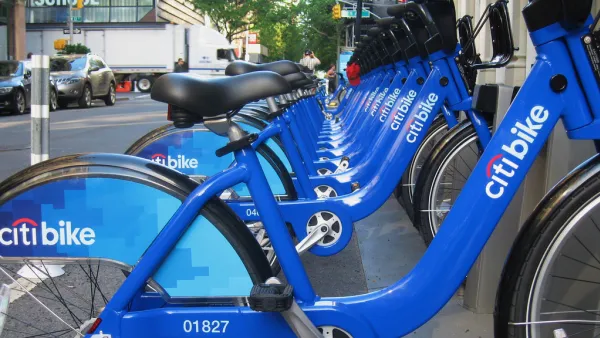
The United States' Top Large City for Biking Is...
Portland (top city in 2012)? Minneapolis (top city in 2010)? No, it's the Big Apple! New York City leaped from #7 in 2012 to the top spot this year for cities with populations of 100,000 or greater.
America's Best Bike Cities
With gas prices at an all time high, bike riding has never looked better. Shermans Travel identifies the top cities to bike through, noting a bounty of amenities to save on costs for the urban biker.
More Cities Ponder the End of Drive-Thrus
Drive-thru fast food restaurants might be a staple of American life, but several U.S. cities are actively considering prohibiting the development of new drive-thrus for the benefit of traffic safety, air quality, and congestion.

Planetizen Federal Action Tracker
A weekly monitor of how Trump’s orders and actions are impacting planners and planning in America.

The state-sanctioned urbicide of Austin
People don’t kill cities. Freeways do.

Colorado’s Largest Data Center Could Rise Next to Homes — Without a Public Hearing
The proposed campus would consume 11 times the power of Denver International Airport; as it has across the country, opposition mounts.

Nation's most wind-powered state turns to coal as data centers increase energy demand
For the first time in decades, Iowa has increased its generation of coal power.

NYC cools commuters with city's first rain garden above a bus stop
New York City officials say the plants in the rain garden can absorb 16 gallons of rainwater during heavy storms.

Brightline West’s future may rely on $6 billion federal loan
The company has until Nov. 2 to make a $400 million equity investment into its proposed high-speed rail line.

FREE Course: Walkable City 1: Why Walkability?
After describing his path towards focusing on walkability as the essence of good planning, Jeff Speck marches through his five principal reasons for making more walkable places.
Reinventing Malls: Planning Alchemy—Turning Gray Fields Into Gold
The course focuses on the opportunities and imperatives that shape reinvention of mall sites.

Greater Baltimore Committee
Eagle County Government
Harvard University Graduate School of Design
The Architects Foundation
University of Cincinnati Online
The Pocatello Development Authority
The Urban Renewal Agency of the City of Pocatello
Journal of the American Planning Association