New York Governor Andrew Cuomo proposes closing the Javits Center and opening a bigger, convention center to spur economic development. Other proposals included new power transmission lines and Las Vegas-style casinos.


In his State of the State address yesterday, Andrew Cuomo, Governer of New York, proposed building a convention center in Queens to replace the existing Javits Center. Cuomo would open the Javits Center site to bid for developers and create a development plan for museums, hotels, and housing on the existing site.
"A new 3.8-million-square-foot exhibition hall and hotel at the Aqueduct racetrack in Jamaica, Queens, would free up 18 windswept acres owned by the state overlooking the Hudson River in Midtown Manhattan, a site occupied since the 1980s by the much- maligned Jacob K. Javits Convention Center," writes Charles Bagli in The New York Times.
"...Still, the question is whether the Queens project makes sense, experts said. The convention business is highly competitive, and attendance is falling around the country. Most convention centers are run by public authorities at a deficit."
Brad Aaron at StreetsBlog offers his first impressions of the convention center plan: "While it's disappointing to see Cuomo tout a glitzy mega-project as economic development while ignoring bread-and-butter issues like subway and bus service (also noted by Gelinas), Streetsblog readers have pointed out one potential upside: Redeveloping the Aqueduct site in Ozone Park could spur reactivation of the LIRR's defunct Rockaway Branch."
Thanks to Elaine Mahoney
Read the full story: First Impressions of the Cuomo Convention Center Plan
For NY Governor, Javits Center is Out
The 80s-era convention center on the far west side of Manhattan would be turned into a mixed-use development and a Malaysian gambling company would instead redevelop the Aqueduct Racetrack in Ozone Park, Queens.
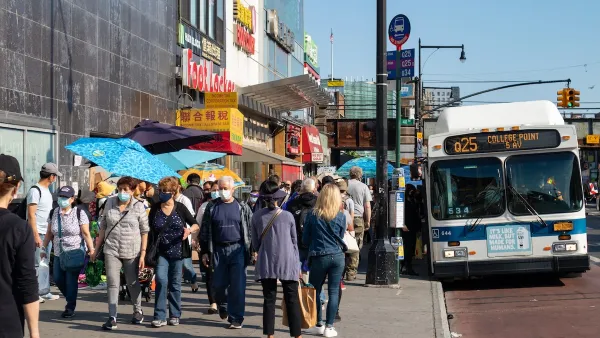
NYC bus network redesign speeds up Queens buses
Rush routes have seen a 4.6% speed increase after the redesign.
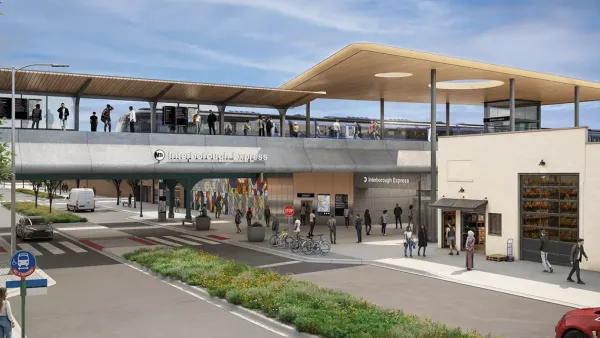
NYC releases new renderings for $5.5 billion Interborough Express
The slated stations will have a modern look, enhanced lighting and improved audio announcements.

Planetizen Federal Action Tracker
A weekly monitor of how Trump’s orders and actions are impacting planners and planning in America.

California plans to bury El Niño’s downpour
If the state plays its cards right, it may be able to store a billion acre-feet of El Niño’s water in aquifers.

Desperate measures: Advocates weigh draining Lake Powell to fill Colorado River
Draining the reservoir could reduce evaporation losses by a couple hundred thousand acre-feet.

Housing is the top priority of Seattle’s sole new councilmember
Jenks campaigned on building 1,000 new units of affordable housing.

New tax cuts may slash $1.5 billion in funding for Miami transit, public parks
Amendment 3 will save Miami-Dade homeowners $2,700 in 2028.

Arizona, Wisconsin, Pennsylvania hope to finally advance climate goals post-midterms
The three states have spent years under Republican or divided control.

FREE Course: Walkable City 1: Why Walkability?
After describing his path towards focusing on walkability as the essence of good planning, Jeff Speck marches through his five principal reasons for making more walkable places.
Reinventing Malls: Planning Alchemy—Turning Gray Fields Into Gold
The course focuses on the opportunities and imperatives that shape reinvention of mall sites.

City of Rosemead
Rutgers University, Edward J. Bloustein School of Planning and Public Policy
One Hundred Miles
University of Michigan School for Environment and Sustainability (SEAS)
Hunter College, City University of New York (CUNY)
The Architects Foundation
City of Cambridge
Montrose County
The Pocatello Development Authority