Trees are an increasingly important part of the urban infrastructure. However, a lack a awareness about how to plant and nurture large trees in urban environments dooms many trees to lackluster performance and a short life.


"Often, cities plant new trees in a few cubic metres of poor-quality soil, with predictable results," writes author Wendy Stueck.
Although significantly more expensive, new technologies offer cities the option to improve the urban canopy by allowing large trees to thrive in urban environments: "Over time, working with American landscape architect James Urban, the company developed the Silva Cell, a system designed to help nurture big trees in urban environments based on research that shows larger trees provide exponentially greater benefits than smaller ones... Silva Cells are a modular system that puts tree roots under buried decks, with a layer of aggregate and pavement over top. The system provides drainage and irrigation and puts roots below the decks, so they don't push up and buckle pavement. It also ensures plentiful volumes of unpacked soil – about 15 to 20 cubic metres in a typical installation, compared with 1.5 to 3 cubic metres for a tree planted in a conventional pit."
Thanks to Brent Toderian
Read the full story: An urban canopy to nurture a city’s growth
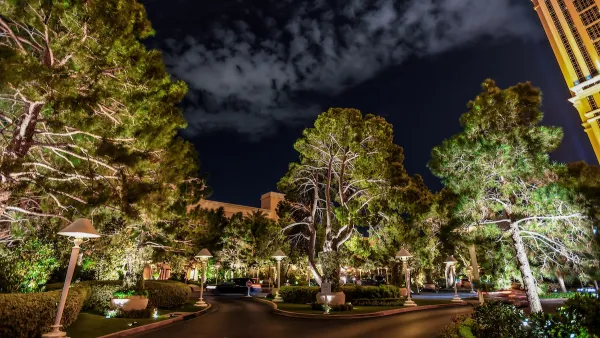
Urban Trees Have Bigger Impact in Hot, Dry Cities
The cooling effect of robust urban tree canopies is more pronounced in hotter, drier cities like Phoenix and Las Vegas.
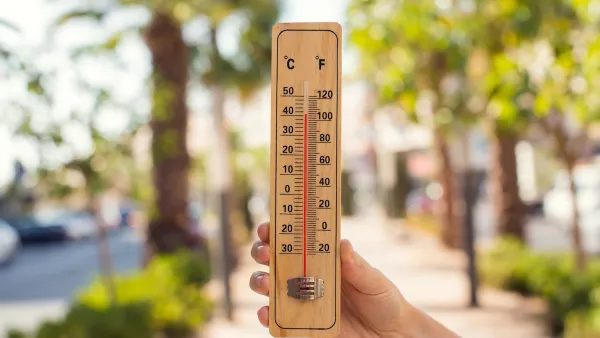
Study: Urban Trees Lose Cooling Benefits in Extreme Heat
A robust tree canopy can help reduce the urban heat island effect and lower air temperatures, but the impact is reduced as temperatures rise.
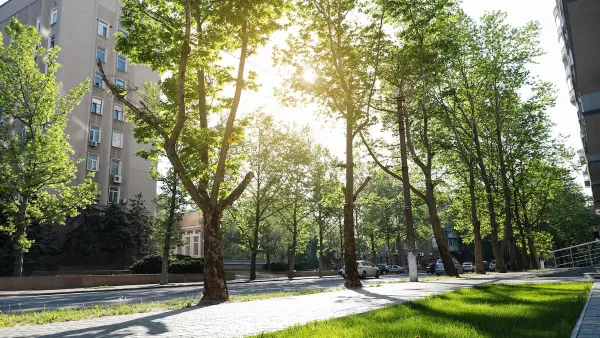
The Economic Value of Street Trees
Far from just providing shade and improving air quality, trees can also contribute to more resilient roads, lower energy costs, and reduced flood risk.

Planetizen Federal Action Tracker
A weekly monitor of how Trump’s orders and actions are impacting planners and planning in America.

California plans to bury El Niño’s downpour
If the state plays its cards right, it may be able to store a billion acre-feet of El Niño’s water in aquifers.

Desperate measures: Advocates weigh draining Lake Powell to fill Colorado River
Draining the reservoir could reduce evaporation losses by a couple hundred thousand acre-feet.

Mamdani’s pied-à-terre tax survives legal challenge
A panel of judges found that the plaintiffs failed to demonstrate injury as a result of New York City's implementation of the tax.

Eastern Nebraska is running out of electricity
Data centers and electrification are straining eastern Nebraska’s grid, throttling economic development.

Seattle passes record-breaking transit services expansion
Proposition 1 will double the city’s transit tax to add 95,000 more bus trips and preserve 180,000 bus trips annually.

FREE Course: Walkable City 1: Why Walkability?
After describing his path towards focusing on walkability as the essence of good planning, Jeff Speck marches through his five principal reasons for making more walkable places.
Reinventing Malls: Planning Alchemy—Turning Gray Fields Into Gold
The course focuses on the opportunities and imperatives that shape reinvention of mall sites.

City of Rosemead
Rutgers University, Edward J. Bloustein School of Planning and Public Policy
One Hundred Miles
University of Michigan School for Environment and Sustainability (SEAS)
Hunter College, City University of New York (CUNY)
The Architects Foundation
City of Cambridge
Montrose County
The Pocatello Development Authority