Ethan Epstein chronicles the work of Seattle's mayor, Mike McGinn, who won office in 2009 from established candidates and a powerful incumbent on a "philosophically anti-car" base.


McGinn's Road Diet, which went into effect in July, is probably his most audacious project. 'As the centerpiece of the city's $240 million "Bicycle Master Plan," which mandates the construction of 118 miles of bike lanes and 19 miles of trails by 2017, the diet will convert 3 percent of Seattle's car lanes into bike lanes.'
McGinn has faced aggressive opposition to his plans from many in a city where the meteorological and topographical reality encourages driving. They have argued that McGinn is too focused on cycling policy to the detriment of a woeful public transit system. "The city is nearly twice the size of Boston in square mileage, yet it has no subway. Seattle's bus service is infrequent and slow-moving, and it's bound to get slower, since city buses will lose some lanes to the road diet," writes Ethan Epstein.
"Maybe it's a sign of these politically polarized times that something as seemingly nonideological as commuting has become the latest manifestation of identity politics. In Seattle and elsewhere, citizens could pay a significant price for that development."
Read the full story: Streetless In Seattle
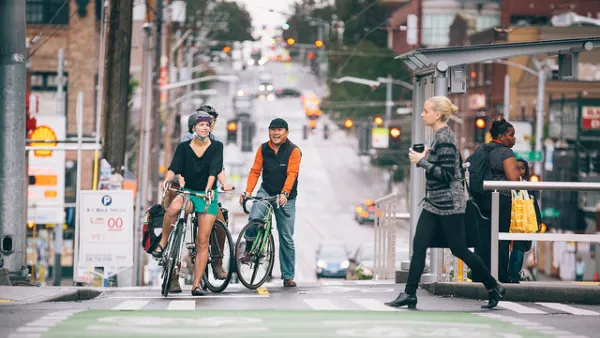
U.S. Cities Reexamine the Discriminatory Effects of Bike Helmet Laws
Data from cities across the country show that bike helmet laws are enforced more aggressively in communities of color.
Opposing Seattle's Big Dig Project
Grist's Dave Roberts chats with Cary Moon, one of the key opponents to Seattle's version of the Big Dig, a tunnel to replace the Alaskan Way Viaduct. Moon, urbanists, and environmentalists are supporting a multi-modal, surface boulevard alternative.
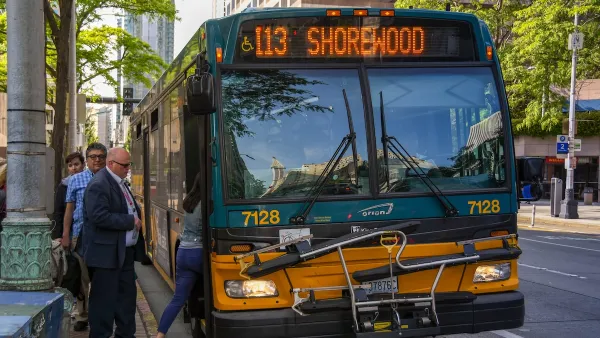
275,000 bus trips are at stake on Seattle's ballot
If passed, the Seattle Transit Measure would trigger a 0.3% sales tax and raise an average of $138 million per year to maintain and expand Seattle’s bus services.

Planetizen Federal Action Tracker
A weekly monitor of how Trump’s orders and actions are impacting planners and planning in America.

California plans to bury El Niño’s downpour
If the state plays its cards right, it may be able to store a billion acre-feet of El Niño’s water in aquifers.

Desperate measures: Advocates weigh draining Lake Powell to fill Colorado River
Draining the reservoir could reduce evaporation losses by a couple hundred thousand acre-feet.

US buildings threatened, destroyed by fires set to triple by 2060
Researchers found a high fire risk for socioeconomically vulnerable neighborhoods in the American West.

LA residents may be allowed to paint their own crosswalks
Councilwoman Katy Yaroslavsky put out a motion instructing the Los Angeles Department of Public Transportation to study the feasibility of allowing volunteers to paint crosswalks.

Dallas moves to overhaul its zoning code
The city's zoning reform will allow more multi-family and mixed-use developments.

FREE Course: Walkable City 1: Why Walkability?
After describing his path towards focusing on walkability as the essence of good planning, Jeff Speck marches through his five principal reasons for making more walkable places.
Reinventing Malls: Planning Alchemy—Turning Gray Fields Into Gold
The course focuses on the opportunities and imperatives that shape reinvention of mall sites.

City of Rosemead
Rutgers University, Edward J. Bloustein School of Planning and Public Policy
One Hundred Miles
Hunter College, City University of New York (CUNY)
The Architects Foundation
University of Cincinnati Online
City of Cambridge
Montrose County
The Pocatello Development Authority