The unfathomable happened this week in Southern California when L.A. converted 2.2 miles of road into a bike lane that stretches along 7th Street from Koreatown to Downtown.


Reporting for The Los Angeles Times, Ari Bloomekatz writes, "Cycling advocates cheered the news as one of the strongest indications yet that Los Angeles is slowly introducing more paths for those pedaling on two wheels. Officials estimate some 27,000 Angelenos ride a bicycle daily."
"Cyclists are not only middle-class white urbanites who can afford a car but choose to not always drive, but also transit-dependent residents in low-income minority communities," notes Allison Mannos of the Los Angeles County Bicycle Coalition.
The newly dedicated bike lane is part of the Bicycle Master Plan that the county adopted earlier this year. But even at a relatively low cost of under $100,000 per mile, "[t]he bike plan calls for more than 200 miles of new routes every five years. [S]ome officials and cycling advocates say there does not appear to be enough funding to reach that goal," adds Bloomekatz.
Read the full story: In traffic-choked L.A., a car lane is given to bicycles
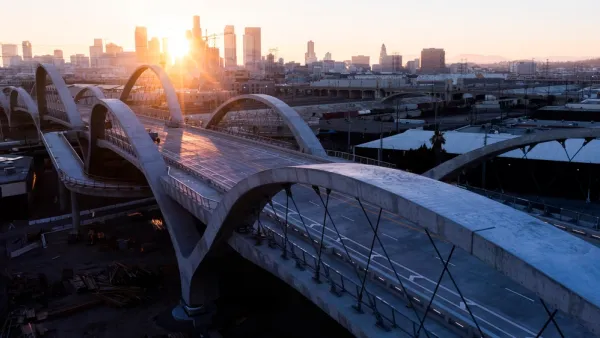
L.A.’s 6th Street Bridge Bike Lane Disappoints
Bike and pedestrian infrastructure on the much-anticipated new bridge leaves much to be desired, according to advocates.
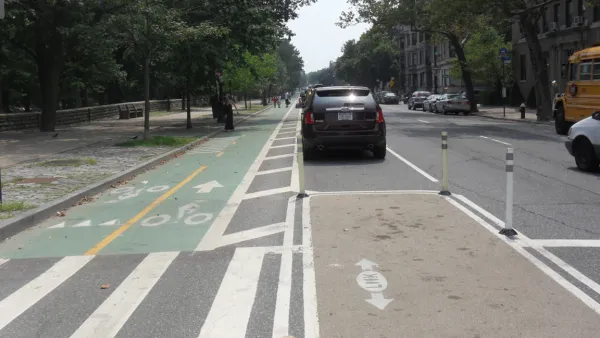
More Bicycle Infrastructure Equals More Riders
Analysis of Census data shows that, while still small in number, more Americans are taking to two-wheels as part of their daily commute.
L.A.'s Bicycle Love Affair: Enduring Relationship or Passing Fancy?
The Los Angeles Times' editorial page declares itself "pro-bike" as it launches "Roadshare", an effort to engage the city's cyclists, drivers, pedestrians, taxpayers and others in a discussion over L.A.'s transportation future.

Planetizen Federal Action Tracker
A weekly monitor of how Trump’s orders and actions are impacting planners and planning in America.

California plans to bury El Niño’s downpour
If the state plays its cards right, it may be able to store a billion acre-feet of El Niño’s water in aquifers.

Desperate measures: Advocates weigh draining Lake Powell to fill Colorado River
Draining the reservoir could reduce evaporation losses by a couple hundred thousand acre-feet.

Mamdani’s pied-à-terre tax survives legal challenge
A panel of judges found that the plaintiffs failed to demonstrate injury as a result of New York City's implementation of the tax.

Eastern Nebraska is running out of electricity
Data centers and electrification are straining eastern Nebraska’s grid, throttling economic development.

Seattle passes record-breaking transit services expansion
Proposition 1 will double the city’s transit tax to add 95,000 more bus trips and preserve 180,000 bus trips annually.

FREE Course: Walkable City 1: Why Walkability?
After describing his path towards focusing on walkability as the essence of good planning, Jeff Speck marches through his five principal reasons for making more walkable places.
Reinventing Malls: Planning Alchemy—Turning Gray Fields Into Gold
The course focuses on the opportunities and imperatives that shape reinvention of mall sites.

City of Rosemead
Rutgers University, Edward J. Bloustein School of Planning and Public Policy
One Hundred Miles
University of Michigan School for Environment and Sustainability (SEAS)
Hunter College, City University of New York (CUNY)
The Architects Foundation
City of Cambridge
Montrose County
The Pocatello Development Authority