Slate looks at the work and vast urban transformations brought about under the leadership of New York City Transportation Commissioner Janette Sadik-Khan.


From bike lanes to street closures, Sadik-Khan's work is praised for its big thinking but also its small-scale.
"How has Sadik-Khan managed to do so much? One tactic that has served her well is to make temporary changes with an eye toward turning them permanent once people get accustomed to them. The mayor's backing hasn't hurt. And her experience in the private sector-she was chief of staff to the CEO of the transportation infrastructure giant Parsons Brinckerhoff-seems to have taught her that coming up with concrete results is more important than trying to please everyone. Even the New Yorkers who oppose her plans grudgingly admit she gets things done.
The bike lane furor still hasn't entirely subsided, but Sadik-Khan is already on to the next big thing-or rather, things: the pedestrian wayfinding project, which will put signs on sidewalks to give pedestrians directions and distances to nearby landmarks; a bike-share plan, modeled on a program that Washington and other cities have implemented to good effect; and Midtown in Motion, which would allow traffic engineers to adjust stoplights remotely as traffic conditions change."
Read the full story: Janette Sadik-Khan, New York City Transportation Commissioner

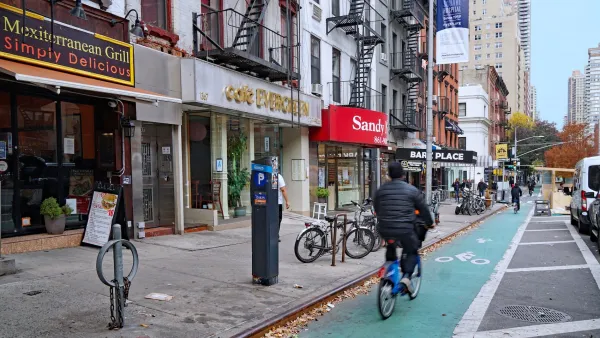
Study: Protected bike lanes increase Citi Bike rides by nearly 400 rides a month
An analysis of millions of NYC bike share rides reveals that only protected bike lanes have a 'statistically significant' increase in ridership.
Mamdani to Revive Multiple Complete Streets Projects Killed by Adams
NYCDOT will restore several proposed bike and bus lanes.
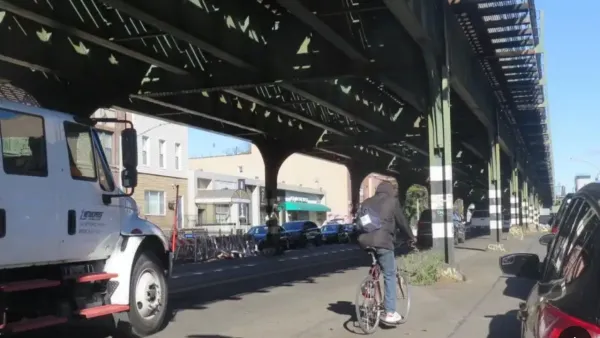
Judge Orders Removal of Queens Bike Lane on One of NYC’s Most Dangerous Corridors
A group of local businesses and a school sued the city, arguing that NYCDOT didn’t follow appropriate procedures and failed to address safety concerns before going ahead with the project.

Planetizen Federal Action Tracker
A weekly monitor of how Trump’s orders and actions are impacting planners and planning in America.

The state-sanctioned urbicide of Austin
People don’t kill cities. Freeways do.

US to reduce Colorado River water deliveries to Mexico
A new Colorado Treaty amendment reduces Mexico’s Colorado River water allocation by 250,000 acre feet.

NYC cools commuters with city's first rain garden above a bus stop
New York City officials say the plants in the rain garden can absorb 16 gallons of rainwater during heavy storms.

Brightline West’s future may rely on $6 billion federal loan
The company has until Nov. 2 to make a $400 million equity investment into its proposed high-speed rail line.

LA Metro’s ultimatum: no extra buses for LA28 if federal funding isn’t imminently secured
If Metro does not provide additional buses, LA28 organizers will have to find a new way to manage Olympic traffic. LA28’s budget does not include a line item for transit.

FREE Course: Walkable City 1: Why Walkability?
After describing his path towards focusing on walkability as the essence of good planning, Jeff Speck marches through his five principal reasons for making more walkable places.
Reinventing Malls: Planning Alchemy—Turning Gray Fields Into Gold
The course focuses on the opportunities and imperatives that shape reinvention of mall sites.

Eagle County Government
Harvard University Graduate School of Design
Nashville Planning Department
The Architects Foundation
University of Cincinnati Online
The Pocatello Development Authority
The Urban Renewal Agency of the City of Pocatello
Journal of the American Planning Association