This post from The Infrastructurist looks at recent arguments for and against high speed rail projects in the U.S. through the lens of spending.


"We begin with the "against" position, defended by Holman Jenkins in a Wall Street Journal column from last week. Writing in response to both the high-speed rail collision in China and the debt ceiling talks, Jenkins blasts the entire U.S. high-speed rail program as a pointless political exercise in spending taxpayer money. He fails to offer any evidence for this position - unless you consider threats of terrorism, comparisons to the Post Office, and a strange attack on electric cars "evidence" - but he's quite certain that improvements to American passenger rail represent nothing more than 'spending money for the sake of spending money'."
On the other side, Matthew Yglesias at ThinkProgress argues for rail spending by arguing against war spending.
Read the full story: For and Against High-Speed Rail, Part V: Spending Edition

Paying the Bill for High Speed Rail in California
The prospect of a high speed rail line connecting California's major cities has been appealing to many in the state. But with less than a quarter of the money needed for the project, the risks are hard to ignore.
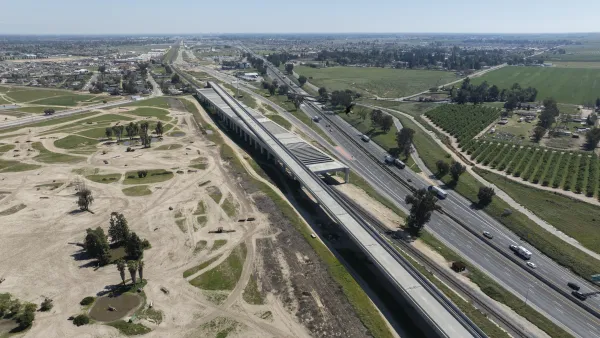
California High-Speed Rail Authority could be broke by the end of 2027
A report from the Office of Inspector General says the authority must borrow against state infusions to stay afloat.
Analysis: What does America want from surface transportation reauthorization?
Over 13,000 comments were submitted in the federal Request for Information on surface transportation reauthorization. We analyzed all of them.

Planetizen Federal Action Tracker
A weekly monitor of how Trump’s orders and actions are impacting planners and planning in America.

Amtrak, CN end decades-long dispute with eight-year agreement
The new operating agreement establishes an updated framework for the companies to work together, including processes to resolve disputes.

Judges permit Denver to divert 77,000 acre feet from the Colorado River for reservoir expansion
Overuse and climate change have caused the Colorado River’s water levels to plummet.

NYC DOT wants faster, more permanent street upgrades
The city is examining ways to build more concrete infrastructure without getting entangled in 'decades-long' projects.

'Something we’ve never seen before:' rising utility rates could strain city finances nationwide
Data centers, climate change and other factors have caused utility rates in the United States to increase by 38% since 2020.

Trump to overrule local leaders, lease millions of acres of America’s Pacific Island territories’ seafloors to mining companies
International law says that the Indigenous people of America’s territories have a right to prior and informed consent regarding projects that impact their countries.

FREE Course: Walkable City 1: Why Walkability?
After describing his path towards focusing on walkability as the essence of good planning, Jeff Speck marches through his five principal reasons for making more walkable places.
Reinventing Malls: Planning Alchemy—Turning Gray Fields Into Gold
The course focuses on the opportunities and imperatives that shape reinvention of mall sites.

Harvard University Graduate School of Design
KFH Group Inc.
Greater Baltimore Committee
The Architects Foundation
University of Cincinnati Online
The Pocatello Development Authority
The Urban Renewal Agency of the City of Pocatello