According to Mayor Bloomberg's latest press release, nearly 19,000 cyclists populate the streets of NYC on a daily basis - that's 2,300 more than last spring. The growing popularity makes the soon to be unveiled bike-sharing system looks promising.


Andrea Bernstein reports:
"New York City says cycling is up by 262 percent since 2000, while, it says, the average risk of serious injury to cyclists declined 72 percent from 2000 to 2010. But the data shows an uptick in serious injuries between 2009 and 2010, from 100 to 113. In the last decade, the city has added nearly 400 miles of bike lanes."
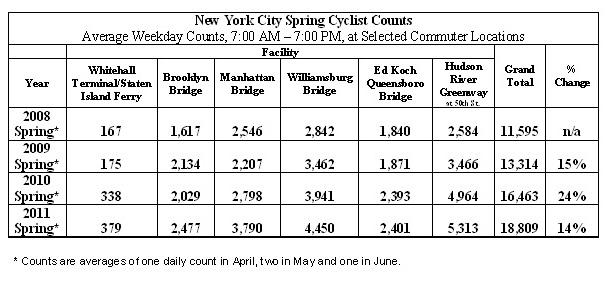
It is noteworthy that NYC uses its own bike count methodology instead of relying on Census information like other cities. Bernstein explains, "New York City began counting cyclists at six heavily biked locations in 1985, when 3,440 cyclists per day were recorded. The locations are: the Manhattan sides of the Brooklyn Bridge, Ed Koch Queensboro Bridge, Manhattan Bridge and the Williamsburg Bridge; at the Whitehall Ferry Terminal and on the Hudson River Greenway at 50th Street."
Read the full story: NYC Biking is Up 14 Percent From 2010; Overall Support Rises
Transportation Brawls of 2010
AltTransport takes a look at the biggest skirmishes in the world of transportation and sustainability that took place over the past calendar year.

Oregon updates coastal bike map for the first time in a decade
The printed guide helps cyclists navigate the coastal region where cellular service can be unpredictable.

Unleashing the Power of Cycling With Smart Messaging
Lloyd Alter describes how creative design and copywriting can flip the script and promote active transport.

Planetizen Federal Action Tracker
A weekly monitor of how Trump’s orders and actions are impacting planners and planning in America.

Eastern Nebraska is running out of electricity
Data centers and electrification are straining eastern Nebraska’s grid, throttling economic development.

Study reveals best places in the U.S. for cycling, walking
New research from Streetlight Data examines bicycle and pedestrian miles per capita in the 100 largest U.S. cities by population.

Federal government nominates new FTA administrator
Mark Aesch is currently the founder and CEO of a transportation management consulting firm.

Developers reveal $10 billion stadium plan as ‘Hail Mary’ to keep Bears in Chicago
The plan would also boast a public park, high- and mid-rise buildings and a youth sports complex.

As Texas embraces carbon storage, a Black community questions the risks
Texas now issues permits for companies to store carbon dioxide underground. East Texas residents fear safety risks, and skeptics doubt the climate benefits.

FREE Course: Walkable City 1: Why Walkability?
After describing his path towards focusing on walkability as the essence of good planning, Jeff Speck marches through his five principal reasons for making more walkable places.
Reinventing Malls: Planning Alchemy—Turning Gray Fields Into Gold
The course focuses on the opportunities and imperatives that shape reinvention of mall sites.

City of Rosemead
Rutgers University, Edward J. Bloustein School of Planning and Public Policy
One Hundred Miles
University of Michigan School for Environment and Sustainability (SEAS)
Hunter College, City University of New York (CUNY)
The Architects Foundation
City of Cambridge
The Pocatello Development Authority
The Urban Renewal Agency of the City of Pocatello