A Brookings Institute report shows that the difference between crime in the suburbs and cities has drastically decreased, and argues that the current drop in crime rates weakens the correlation between ethnic groups and crime.


In the 100 largest metro areas, violent and property crime between 1990 and 2008 decreased the most in cities.
"The gap between city and suburban violent crime rates declined in nearly two-thirds of metro areas. In 90 of the 100 largest metro areas, the gap between city and suburban property crime rates narrowed from 1990 to 2008. In most metro areas, city and suburban crime rates rose or fell together."
"Within metropolitan areas, older, more urbanized, poorer, and more minority communities have benefited the most from these trends, narrowing the disparities between cities and suburbs and underscoring that crime is not a uniquely urban issue, but a metropolitan one."
Read the full story: City and Suburban Crime Trends in Metropolitan America

Which cities are (perceived as) safest?
A Gallup poll asked residents of each Congressional district whether they felt safe walking alone at night in their city or area. Although city residents feared crime more than suburbs, there were some surprises.
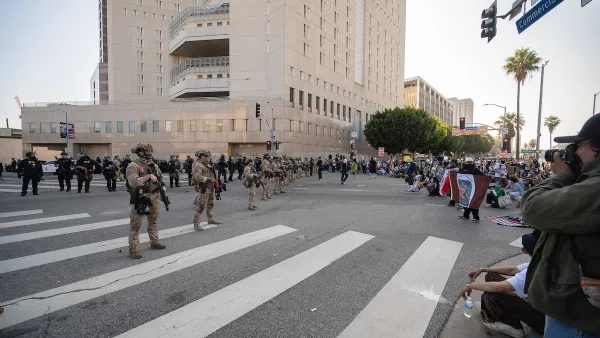
Opinion: Far From Cauldrons of Violence, Cities are Anti-Crime Innovators
Rather than funding the performative militarization of law enforcement, the federal government could instead support programs that prevent poverty and crime before it happens.

Census: Big Cities Lost Population During the Pandemic
For the first time in at least three decades, major metropolitan areas in the U.S. showed negative population growth during the peak of the COVID-19 pandemic.

Planetizen Federal Action Tracker
A weekly monitor of how Trump’s orders and actions are impacting planners and planning in America.

Amtrak, CN end decades-long dispute with eight-year agreement
The new operating agreement establishes an updated framework for the companies to work together, including processes to resolve disputes.

Judges permit Denver to divert 77,000 acre feet from the Colorado River for reservoir expansion
Overuse and climate change have caused the Colorado River’s water levels to plummet.

Alabama scores up to $2.5 billion federal loan for largest infrastructure project in state’s history
The Mobile River Bridge and Bayway Project aims to ease congestion at Alabama’s worst bottleneck.

Trump is considering data centers on 6 states' public land — some state officials say they had no idea
If the administration approves the proposed projects, data center and data center-related developments will cover 17,600 acres of public land.

Despite court ruling, Trump is keeping nearly all wind projects in the US on hold
At least 110 wind energy projects have not heard from the government since a federal judge ruled that the Trump administration's freeze on wind turbine clearances was likely illegal.

FREE Course: Walkable City 1: Why Walkability?
After describing his path towards focusing on walkability as the essence of good planning, Jeff Speck marches through his five principal reasons for making more walkable places.
Reinventing Malls: Planning Alchemy—Turning Gray Fields Into Gold
The course focuses on the opportunities and imperatives that shape reinvention of mall sites.

KFH Group Inc.
Greater Baltimore Committee
Eagle County Government
The Architects Foundation
University of Cincinnati Online
The Pocatello Development Authority
The Urban Renewal Agency of the City of Pocatello