Photographer Daniel Kariko focuses on issues of land use in sensitive environments. His latest work looks at stalled suburban housing developments in the U.S.


This piece from Domus interviews Kariko and shows some of his work.
"Domus: Due to the host of recent projects out there on foreclosed homes, that contemporary aesthetic is starting to seem cliché. These images of incomplete developments have something in common, but there is also an uncanny sense of suspended animation. How did you contend with the aesthetics of this project?
Daniel Kariko: I'm mostly interested in the content of the scene I'm depicting. The aesthetic is often a tool to draw in the viewer, so I can tell them my story. Any particular aesthetic, to me, exists as a top layer of the image, and, when peeled off, reveals a visual metaphor I intend to portray.
The sense of suspended animation is real-it is there when you drive through these subdivisions. In Lehigh Acres, one of the oldest communities, there might be entire blocks with several houses, with only one or two inhabited ones. For my aerial images, I typically chose to include the ones with no evidence of construction equipment, which was not that hard to do-99% of the images I made at that time were empty of any kind of discernable building activity."
Read the full story: Daniel Kariko: SpeculationWorld

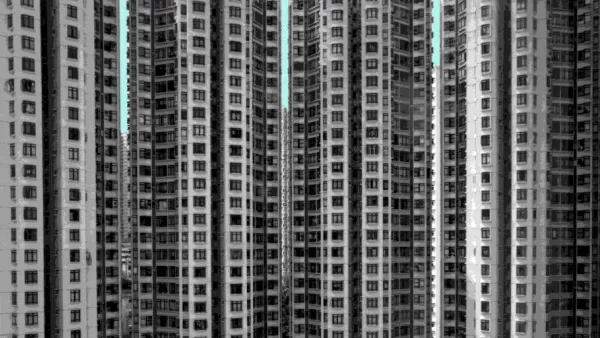
Friday Eye Candy: Built Environments Expanded Beyond Wildest Dreams
The work of Marcus Lyons replicates images of already sprawling human development to the breaking point and maybe beyond.
Transforming the City Through Photography
The photographic distortions of architect and photographer Murat Germen take cities as their target, and transform them into single-axis representations of urban form and history.
Looking Down on Sprawl
Writing in The New York Times, Geoff Manaugh looks at Christoph Gielen's aerial photography of urban development and sprawl.

Planetizen Federal Action Tracker
A weekly monitor of how Trump’s orders and actions are impacting planners and planning in America.

California plans to bury El Niño’s downpour
If the state plays its cards right, it may be able to store a billion acre-feet of El Niño’s water in aquifers.

Chicago breaks ground on $3 billion megadevelopment
The new neighborhood, titled Foundry Park, will one day host 3,700 residences.

Want to study the Missouri River? Soon, you may need unanimous approval from 10 states
Legislation would require 10 governors’ permission to study or build projects moving water outside the basin.

Desperate measures: Advocates weigh draining Lake Powell to fill Colorado River
Draining the reservoir could reduce evaporation losses by a couple hundred thousand acre-feet.

This road in NYC is infamously dangerous — and Mamdani can't fix it
New York City's Ocean Parkway is known for reckless driving, but the power to implement safety measures lies with the state rather than the city.

FREE Course: Walkable City 1: Why Walkability?
After describing his path towards focusing on walkability as the essence of good planning, Jeff Speck marches through his five principal reasons for making more walkable places.
Reinventing Malls: Planning Alchemy—Turning Gray Fields Into Gold
The course focuses on the opportunities and imperatives that shape reinvention of mall sites.

City of Rosemead
Rutgers University, Edward J. Bloustein School of Planning and Public Policy
One Hundred Miles
Hunter College, City University of New York (CUNY)
The Architects Foundation
University of Cincinnati Online
City of Cambridge
Montrose County
The Pocatello Development Authority