The project converted a nine-acre parking lot into an ambitious urbanist community, which revitalized a nearby natural water channel, added high density housing, retail, and integrated a walkable design.


Grist contributor Kaid Benfield describes how the redevelopment plan has benefited Seattle's Thorton Creek, Thorton Place, Alijoya communities:
"The redevelopment not only added 530 units of housing (net density: 96 units per acre) and 50,000 square feet of retail space; it simultaneously accomplished the following, according to the (Landscape Architecture Foundation):
"-Increased open space within the Northgate Urban Center by about 50 percent.
"-Provided pedestrian links from adjacent commercial and residential neighborhoods, shortening walking distances by 50 percent.
"-Reduced impervious surfaces by 78 percent."
...and much more, according to Benfield.
Thanks to Kristopher Fortin
Read the full story: A Seattle development that is greener than green

Northwest Arkansas grapples with growth as it prepares to host New Urbanism gathering
A compelling story of a fast-growing, polycentric region grappling with identity and affordability, Susan Henderson reframes CNU 34 as a hands-on workshop, inviting planners to explore Northwest Arkansas as it decides what it will become.
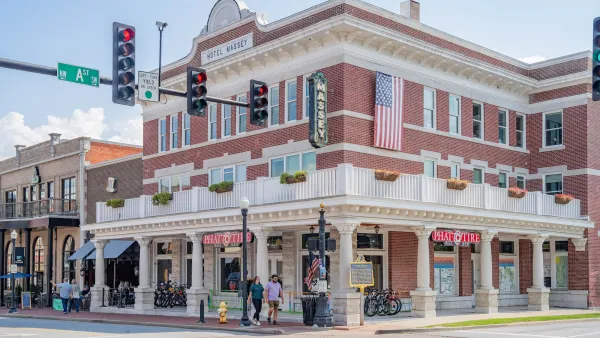
A New Urbanist’s roadtrip guide to Northwest Arkansas
Heading to the CNU conference next month? A Northwest Arkansas urban planner has custom designed a roadtrip just for you.

Study: Americans Spending Less Time Interacting in Public Space
American pedestrians are moving faster and spending less time connecting with other people when walking down city streets.

Planetizen Federal Action Tracker
A weekly monitor of how Trump’s orders and actions are impacting planners and planning in America.

California plans to bury El Niño’s downpour
If the state plays its cards right, it may be able to store a billion acre-feet of El Niño’s water in aquifers.

Desperate measures: Advocates weigh draining Lake Powell to fill Colorado River
Draining the reservoir could reduce evaporation losses by a couple hundred thousand acre-feet.

Los Angeles just elected an urban planner as its mayor
Transportation analysts are optimistic that Raman will be more aggressive in addressing transit issues than Bass.

Mamdani’s pied-à-terre tax survives legal challenge
A panel of judges found that the plaintiffs failed to demonstrate injury as a result of New York City's implementation of the tax.

Eastern Nebraska is running out of electricity
Data centers and electrification are straining eastern Nebraska’s grid, throttling economic development.

FREE Course: Walkable City 1: Why Walkability?
After describing his path towards focusing on walkability as the essence of good planning, Jeff Speck marches through his five principal reasons for making more walkable places.
Reinventing Malls: Planning Alchemy—Turning Gray Fields Into Gold
The course focuses on the opportunities and imperatives that shape reinvention of mall sites.

City of Rosemead
Rutgers University, Edward J. Bloustein School of Planning and Public Policy
One Hundred Miles
University of Michigan School for Environment and Sustainability (SEAS)
Hunter College, City University of New York (CUNY)
The Architects Foundation
City of Cambridge
Montrose County
The Pocatello Development Authority