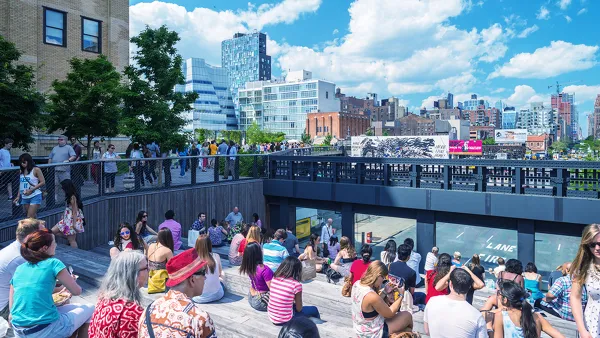
Witold Rybczynski thinks not, saying that the success of the project's "landscape urbanism" is its remarkably dense and urban setting, not the hip design and landscaping.


As the new section of the High Line is set to open, Rybczynski says that landscape urbanists are readying to point to the site as the success story of their movement, a model for future town planning. Rybczynski thinks that is ill-advised.
He writes:
"The High Line may be a landscaping project, but a good part of its success is due to its architectural setting, which, like the 12th Arrondissement, is crowded with interesting old and new buildings. The park courses through the meatpacking district and Chelsea, heavily populated, high-energy residential neighborhoods. Very few American cities - and Manhattan is the densest urban area in the country - can offer the same combination of history and density."
Rybczynski also points to the great expense of the project and other reasons why a High Line would likely not work out in a Des Moines or Phoenix.
Read the full story: Bringing the High Line Back to Earth
The Urban Landscape Rock Star
Continuing to heap praise onto James Corner and his firm, Field Operations, may seem like an exercise in redundancy at this point. But there is little doubt that all of the attention is good for landscape architects—and for cities.

DC Park Aims for Equitable Development
Project leaders working on the 11th Street Bridge Park hope to prevent displacement of residents and bring economic and social benefits to the surrounding community.
Tokyo Expressway to Become a Linear Park
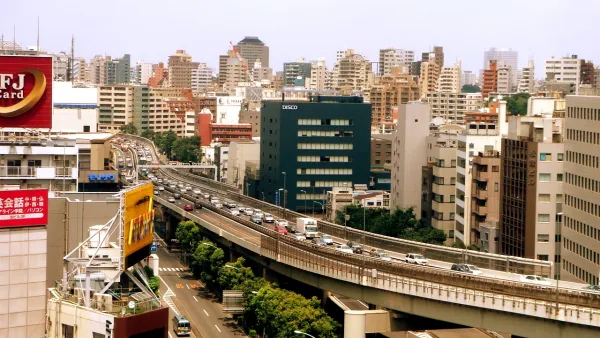
A major expressway in Ginza will be converted to a park similar to New York City's High Line.

Planetizen Federal Action Tracker
A weekly monitor of how Trump’s orders and actions are impacting planners and planning in America.

California plans to bury El Niño’s downpour
If the state plays its cards right, it may be able to store a billion acre-feet of El Niño’s water in aquifers.

Desperate measures: Advocates weigh draining Lake Powell to fill Colorado River
Draining the reservoir could reduce evaporation losses by a couple hundred thousand acre-feet.

US buildings threatened, destroyed by fires set to triple by 2060
Researchers found a high fire risk for socioeconomically vulnerable neighborhoods in the American West.

LA residents may be allowed to paint their own crosswalks
Councilwoman Katy Yaroslavsky put out a motion instructing the Los Angeles Department of Public Transportation to study the feasibility of allowing volunteers to paint crosswalks.

Dallas moves to overhaul its zoning code
The city's zoning reform will allow more multi-family and mixed-use developments.

FREE Course: Walkable City 1: Why Walkability?
After describing his path towards focusing on walkability as the essence of good planning, Jeff Speck marches through his five principal reasons for making more walkable places.
Reinventing Malls: Planning Alchemy—Turning Gray Fields Into Gold
The course focuses on the opportunities and imperatives that shape reinvention of mall sites.

City of Rosemead
Rutgers University, Edward J. Bloustein School of Planning and Public Policy
One Hundred Miles
Hunter College, City University of New York (CUNY)
The Architects Foundation
University of Cincinnati Online
City of Cambridge
Montrose County
The Pocatello Development Authority