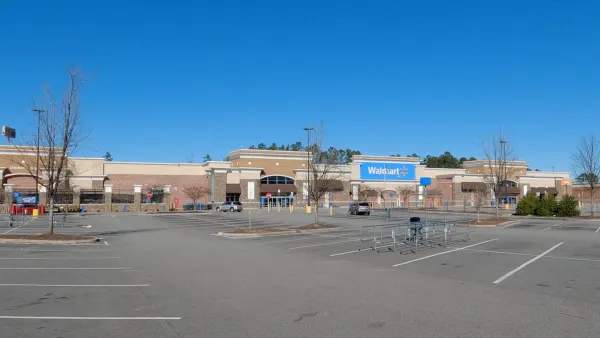
Access to healthy food is a major issue in public health. But just because there's a grocery store nearby doesn't mean health will improve. One entrepreneur looking at supermarket design says the way stores are laid out negatively affects health.


Public health expert Rupal Sanghvi says that supermarkets are designed to sell higher profit margin food -- which happens to be worse for you.
"Sanghvi took it upon herself to start connecting the dots between architecture, environmental design, and public health. In the year since establishing HealthxDesign, she has partnered with design professionals to investigate solutions ranging from sustainable building strategies for Bolivia's health care infrastructure to product design interventions for preventing infant mortality in impoverished communities. Now she has set her sights on the federal government's supermarket spending plan, with a proposal to rethink the store design template.
'The current supermarket template is not behavior neutral,' Sanghvi explains. 'The more times you bump into something at eye level, the more likely you are to purchase it, and store owners are aware of this. There's a lot of product placement and they're all about having the candy in front of the cash register for kids.'
Trying to encourage impulse buys may be obvious, but some factors driving shopping behaviors are more subtle. Bakeries are located toward the back of the store so the aroma will draw shoppers past items that might not be on their list, but which are likely to end up in the cart if spotted. Likewise dairy cases-where almost every shopper goes on every visit-tend to be in the rear. And for anyone who has ever wondered why supermarkets tend to be chilly, Sanghvi reports that heavy A/C actually triggers a basic human instinct: when we're cold, we want to accumulate more food."
Read the full story: A Better Way to Fight Obesity: New, Smarter Supermarkets


January Must-Reads: Top 10 Articles From Last Month
How a tidal wave of potential changes at the federal level could throw many programs planners depend on into chaos, a roundup of last year’s zoning stories, and the continuing ripple effects of a landmark Supreme Court case.
How Smaller Supermarkets Could Transform American Communities
Bigger is not always better.

Local, Organic Farms Won't Save the Food System
The food movement has succeeded in identifying and raising awareness about the vast environmental and public health risks inherent in the world's food systems. Still waiting for a clear path to sustainability, however, is what to do about it.

Planetizen Federal Action Tracker
A weekly monitor of how Trump’s orders and actions are impacting planners and planning in America.

Amtrak, CN end decades-long dispute with eight-year agreement
The new operating agreement establishes an updated framework for the companies to work together, including processes to resolve disputes.

Northwest rail fans eager for Sept. 30 debut of Amtrak’s Airo fleet
Get ready for that new train smell and more seats. But they won’t go faster or run more frequently on the Cascades route in Washington and Oregon.

Brightline Florida files for bankruptcy
The transit company is over $5 billion in debt.

St. Louis Metro to test if single-car trains can reduce operating costs, maintain rider satisfaction
The pilot program will run from October to spring 2027, and begin with one single-car train operating on Metrolink’s Red and Blue lines.

Pennsylvania is building data centers in abandoned mines
Housing data centers in mines provides an alternative to destroying local forests and may spare residents from data centers’ noise and air pollution.

FREE Course: Walkable City 1: Why Walkability?
After describing his path towards focusing on walkability as the essence of good planning, Jeff Speck marches through his five principal reasons for making more walkable places.
Reinventing Malls: Planning Alchemy—Turning Gray Fields Into Gold
The course focuses on the opportunities and imperatives that shape reinvention of mall sites.

City of Thousand Oaks
City of Wisconsin Rapids
Harvard University Graduate School of Design
The Architects Foundation
University of Cincinnati Online
The Pocatello Development Authority
The Urban Renewal Agency of the City of Pocatello