In a review of the new bike sharing program in London, The Economist raises the question of whether the city wrongly predicted the existing demand for the service.


Peak demand has been less than half of what officials expected. But those running the program argue it's still in its early stages.
"Some observers wonder whether TfL has fundamentally misjudged the nature of bike demand. Its own feasibility study, published in 2008, acknowledged that the scheme could not afford to cater for the "after-rail" market (ie, longer-distance railway passengers wanting to finish their journeys by bike), lest it be swamped by the number of commuters arriving in London every morning. Docking stations were deliberately placed away from big railway terminals. But rail commuters appear to have piled onto the bikes anyway."
Read the full story: Grit in the gears

How Boosting Biking Could Improve London's Economy
A new study outlines the potential economic, environmental, and public health benefits of increasing cycling mode share in London, which has pledged to achieve net-zero emissions by 2030.
This is How the British Started Cycling More
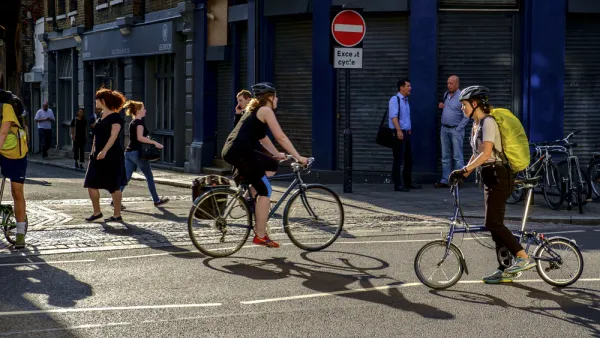
Cycling has never felt more relevant or encouraged in the UK. Since May, the London Councils have upgraded 60 km of bike lanes in the capital city, added 20,000 square metres of extra pavement space, and installed 1,500+ additional cycle parking.

Different Spokes for Different Folks
Bike sharing and rental systems are becoming more inclusive, considering the needs of those with disabilities and children. And systems are expanding based different uses people have for different types of bicycles.

Planetizen Federal Action Tracker
A weekly monitor of how Trump’s orders and actions are impacting planners and planning in America.

Amtrak, CN end decades-long dispute with eight-year agreement
The new operating agreement establishes an updated framework for the companies to work together, including processes to resolve disputes.

Judges permit Denver to divert 77,000 acre feet from the Colorado River for reservoir expansion
Overuse and climate change have caused the Colorado River’s water levels to plummet.

NYC DOT wants faster, more permanent street upgrades
The city is examining ways to build more concrete infrastructure without getting entangled in 'decades-long' projects.

'Something we’ve never seen before:' rising utility rates could strain city finances nationwide
Data centers, climate change and other factors have caused utility rates in the United States to increase by 38% since 2020.

Trump to overrule local leaders, lease millions of acres of America’s Pacific Island territories’ seafloors to mining companies
International law says that the Indigenous people of America’s territories have a right to prior and informed consent regarding projects that impact their countries.

FREE Course: Walkable City 1: Why Walkability?
After describing his path towards focusing on walkability as the essence of good planning, Jeff Speck marches through his five principal reasons for making more walkable places.
Reinventing Malls: Planning Alchemy—Turning Gray Fields Into Gold
The course focuses on the opportunities and imperatives that shape reinvention of mall sites.

Harvard University Graduate School of Design
KFH Group Inc.
Greater Baltimore Committee
The Architects Foundation
University of Cincinnati Online
The Pocatello Development Authority
The Urban Renewal Agency of the City of Pocatello