Japan's yard-less city dwellers are increasingly drawn to "weekend farming" plots rented from commercial farmers on the urban fringe. Could it help the country's struggling agriculture sector? Kenji Hall reports.


Though there is no comprehensive data on the subject, anecdotal evidence suggests a growth in the number of urban families are trying their hand at farming, says Hall. In Tokyo, where residents can rent 150 square feet patches of public land, applicants exceed the number of plots 3-to-1.
Families are also renting plots from farmers at city edges--a small step towards strengthening Japan's agricultural industry, which has long been in decline, according to Hall. The nation's farmers are disadvantaged against global competitors due to outdated distribution systems and small scale. Japanese farms average 4.7 acres compared to 490 acres for American farms.
Hall writes:
"As of February, 979,000 acres, or 10% of Japan's farmland, sat empty, according to Agriculture Ministry data. Dormant fields are a lost opportunity in a country where only about a third of the land is arable...Eager to put unused farmland to use, the government has offered subsidies to farmers who avail their fields and expertise to couples, families and schoolchildren."
Read the full story: Some Japanese take up weekend farming
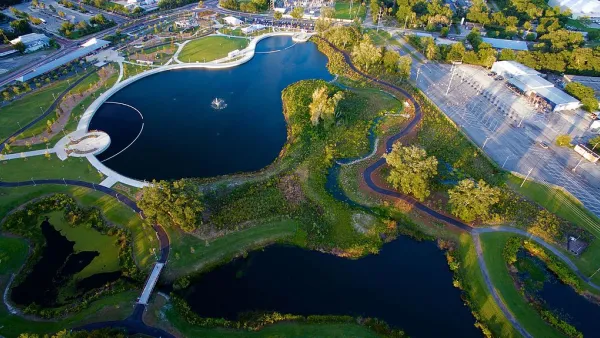
Gainesville Turns Abandoned Industrial Hub Into Innovative Park
Gainesville turns contaminated land into a contemporary public greenspace to serve as the city's “Central Park."
Control of Farmland—City Style
Farm land ownership matters on the edges of metropolitan areas, where farmers can find lucrative markets for their products and yet, with ever escalating land prices, face daunting odds in securing land to grow on or even to get started.
Rethinking Detroit
Detroit reporter John Gallagher's new book "Reimagining Detroit" considers what it will take to remake The Motor City into a model that will work for the future.

Planetizen Federal Action Tracker
A weekly monitor of how Trump’s orders and actions are impacting planners and planning in America.

California plans to bury El Niño’s downpour
If the state plays its cards right, it may be able to store a billion acre-feet of El Niño’s water in aquifers.

Desperate measures: Advocates weigh draining Lake Powell to fill Colorado River
Draining the reservoir could reduce evaporation losses by a couple hundred thousand acre-feet.

Los Angeles just elected an urban planner as its mayor
Transportation analysts are optimistic that Raman will be more aggressive in addressing transit issues than Bass.

Mamdani’s pied-à-terre tax survives legal challenge
A panel of judges found that the plaintiffs failed to demonstrate injury as a result of New York City's implementation of the tax.

Eastern Nebraska is running out of electricity
Data centers and electrification are straining eastern Nebraska’s grid, throttling economic development.

FREE Course: Walkable City 1: Why Walkability?
After describing his path towards focusing on walkability as the essence of good planning, Jeff Speck marches through his five principal reasons for making more walkable places.
Reinventing Malls: Planning Alchemy—Turning Gray Fields Into Gold
The course focuses on the opportunities and imperatives that shape reinvention of mall sites.

City of Rosemead
Rutgers University, Edward J. Bloustein School of Planning and Public Policy
One Hundred Miles
University of Michigan School for Environment and Sustainability (SEAS)
Hunter College, City University of New York (CUNY)
The Architects Foundation
City of Cambridge
Montrose County
The Pocatello Development Authority