Los Angeles architect Roger Sherman is trying to help guide the car-centric L.A. area into harmonious coexistence with the state's planned high speed rail.


Sherman is looking at a variety of scenarios for Anaheim, Norwalk, and Burbank that would react in various ways to the impact of high speed rail on those communities.
"Some municipalities are turning to New Urbanism for quick-fix solutions on how to integrate high-speed rail into cities. Sherman positions himself as a distinct alternative to that. New Urbanism seems a bit too paint-by-numbers for him. 'The New Urbanist approach is more like a template that they can develop quickly, so it is the method favored by planners that have already been hired by a lot of cities because they're trying to impress [high-speed rail advocates] with their level of preparedness.'
'The New Urbanist credo would be mixed-use, mixed-use, mixed-use,' he says. 'But building mixed-use housing makes no sense if you don't have reason to believe a lot of people are going to live there and use high-speed rail. High ticket prices really affect the dynamics as to who, realistically, will use it,' Sherman cautions. 'Because of this cost, it can't be looked at as something that would be akin to typical commuter rail,' he reasons."
Read the full story: Preparing the Automobile City for High-Speed Rail
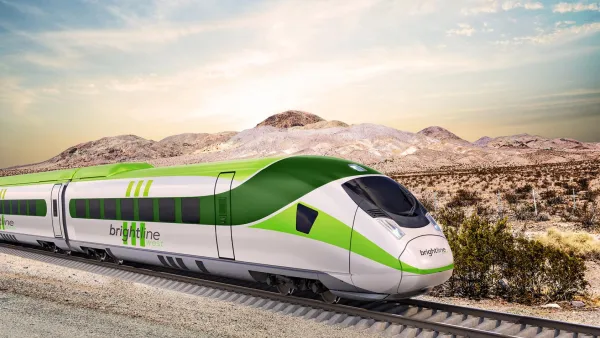
L.A.-Las Vegas High Speed Rail Could Break Ground Next Year
The privately funded train would shuttle passengers between Los Angeles and Las Vegas in half the time it takes to drive and could take 3 million vehicles off the road.
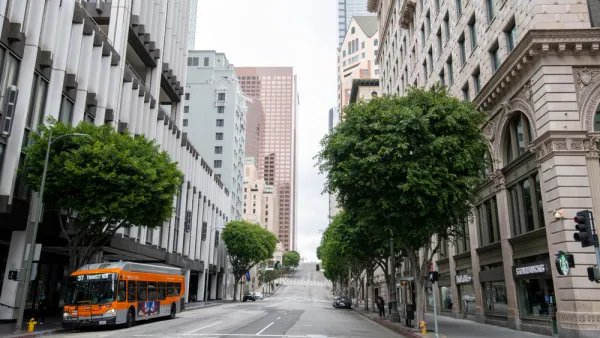
L.A. Metro Plans for an Equitable Recovery
The pandemic has forced difficult confrontations with inequities that existed long before the novel coronavirus. L.A. Metro planners are responding by charting a path toward a transportation system that reverses and improves those previous realities.
Two Options for L.A. High Speed Rail Station
High speed rail is slowly transitioning from idea to reality in California, and one of its major stops will be in Los Angeles. But exactly where in Los Angeles remains an unanswered question.

Planetizen Federal Action Tracker
A weekly monitor of how Trump’s orders and actions are impacting planners and planning in America.

Eastern Nebraska is running out of electricity
Data centers and electrification are straining eastern Nebraska’s grid, throttling economic development.

Study reveals best places in the U.S. for cycling, walking
New research from Streetlight Data examines bicycle and pedestrian miles per capita in the 100 largest U.S. cities by population.

DSA members accuse Mamdani of 'abandoning values' over housing redevelopment
New York City's mayor plans to replace about 2,000 units of public housing with private, mixed-income housing.

All sides of BRT debate unhappy with CDOT’s most recent move
The Colorado Department of Transportation is no longer considering center-running bus lanes for Colorado Boulevard.

Massachusetts bogs generate both power, and cranberries
Putting solar panels above farmland is one way Massachusetts is advancing toward its goal of net-zero carbon emissions by 2050.

FREE Course: Walkable City 1: Why Walkability?
After describing his path towards focusing on walkability as the essence of good planning, Jeff Speck marches through his five principal reasons for making more walkable places.
Reinventing Malls: Planning Alchemy—Turning Gray Fields Into Gold
The course focuses on the opportunities and imperatives that shape reinvention of mall sites.

City of Rosemead
Rutgers University, Edward J. Bloustein School of Planning and Public Policy
One Hundred Miles
University of Michigan School for Environment and Sustainability (SEAS)
Hunter College, City University of New York (CUNY)
The Architects Foundation
City of Cambridge
The Pocatello Development Authority
The Urban Renewal Agency of the City of Pocatello