Transportation Secretary Ray LaHood recently warned incoming Republican governors in Wisconsin and Ohio that dedicated stimulus funds must be spent on high-speed rail or returned, CNN reports.


In separate letters, LaHood appealed to Wisconsin governor-elect Scott Walker and Ohio's John Kasich to keep alive active high-speed rail construction in their states, citing potential economic growth and job creation. The Transportation Department has committed $823 million to a Chicago-Minneapolis route, which includes a Milwaukee-Madison segment, and $400 million to an intercity Cleveland-Columbus-Dayton-Cincinnati line. Both governors-elect publicly oppose the rail projects.
LaHood also cautioned that the funds cannot be diverted to other projects, such as road construction or freight line improvements, Steve Kastenbaum says:
"Lahood wrote that he respects the power of governors to make decisions for their states, but, 'There seems to be some confusion about how these high-speed rail dollars can be spent.'"
Read the full story: LaHood to states: Proceed with rail projects or give up stimulus funds

Economic Stimulus: Another Chance for High-Speed Rail in the U.S.?
High-speed rail advocates in the Pacific Northwest are pushing for a high-speed link between Vancouver, Seattle, and Portland to be part of future economic stimulus spending in the United States.
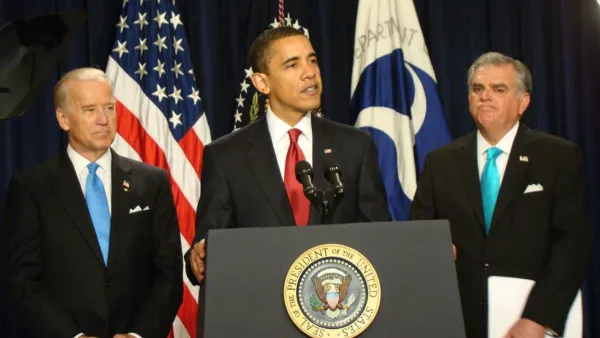
Leave Transit Projects to Transit Experts, Not Politicians
Stephen Smith sheds light on the problems of leadership holding back Obama's dream of high-speed rail.
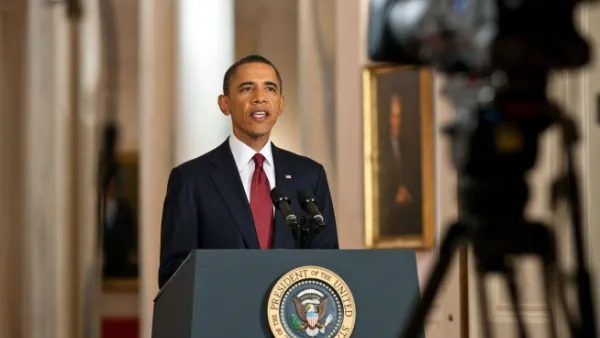
Grading Obama's Approach to Transportation
Was Obama's top transportation achievement his decision to name Ray LaHood as U.S. DOT secretary? That's the argument Tanya Snyder makes in evaluating the President's hits and misses regarding transportation policy.

Planetizen Federal Action Tracker
A weekly monitor of how Trump’s orders and actions are impacting planners and planning in America.

Eastern Nebraska is running out of electricity
Data centers and electrification are straining eastern Nebraska’s grid, throttling economic development.

Study reveals best places in the U.S. for cycling, walking
New research from Streetlight Data examines bicycle and pedestrian miles per capita in the 100 largest U.S. cities by population.

Strained electrical grid forces San Francisco to choose: housing, or data centers?
The city is approaching its maximum grid capacity, leaving leaders with tough choices about what projects to siphon energy toward.

Next-generation nuclear reactors are coming to Texas
The reactors will not require towering containment structures thanks to new safety features.

California distributes $1.3 billion to prevent transit service cuts, bolster projects
Twenty-eight projects across California received a portion of the funding.

FREE Course: Walkable City 1: Why Walkability?
After describing his path towards focusing on walkability as the essence of good planning, Jeff Speck marches through his five principal reasons for making more walkable places.
Reinventing Malls: Planning Alchemy—Turning Gray Fields Into Gold
The course focuses on the opportunities and imperatives that shape reinvention of mall sites.

City of Charlotte
City of Rosemead
Rutgers University, Edward J. Bloustein School of Planning and Public Policy
University of Michigan School for Environment and Sustainability (SEAS)
Hunter College, City University of New York (CUNY)
The Architects Foundation
City of Cambridge
The Pocatello Development Authority
The Urban Renewal Agency of the City of Pocatello