There are two magnetic poles in the realm of urban planning: Robert Moses and Jane Jacobs. But do we have to always be stuck in this tug-of-war?


This piece from Urban Omnibus delves into the polarity between Moses and Jacobs and wonders whether there might be a way to refresh the debate.
"Both the excesses of Robert Moses and the achievements of Jane Jacobs have been well rehearsed by now. The particulars of their battle are specific to their time and place but its legacy remains relevant and has become even more urgent. In the intervening years, many in the architecture and planning community have reached a sensible consensus that 'No city can survive without the personal engagements beloved by Jacobs, but no city can thrive without master builders such as Moses,' as Edward Glaeser put it in his article in The New Republic last year.
The argument for this balanced view has been eloquently made by a number of critics. They also take pains to remind us that the "good" Moses, who left a legacy of numerous parkland and infrastructure projects still benefiting the public, and who actually managed to get things built, should not be lost in the heat of the battle. But in the real world Jane Jacobs has carried the day."
Read the full story: Forever Trapped Between Jacobs and Moses
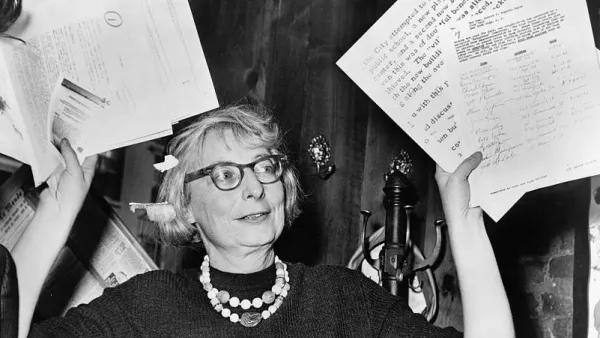
'Citizen Jane' Sets the Battle Lines for the Future of Cities
Coinciding with the 101st anniversary of Jane Jacobs's birth, a documentary film showing in select theaters around the country recounts the history between Jane Jacobs and Robert Moses, and the ideas that forced their struggle.
Reviews for 'Citizen Jane: Battle for the City'
Two publications likely to find an audience with people sympathetic to the cause of Jane Jacobs reviewed the latest film about her political battles with Robert Moses for the soul of New York.
100 Years After Her Birth, Jane Jacobs Might Not Recognize New York
Sam Hall Kaplan reviews "Eyes on Street: The Life of Jane Jacobs" and offers insight gained from personal experience with the "Saint of City Planning."

Planetizen Federal Action Tracker
A weekly monitor of how Trump’s orders and actions are impacting planners and planning in America.

California plans to bury El Niño’s downpour
If the state plays its cards right, it may be able to store a billion acre-feet of El Niño’s water in aquifers.

Desperate measures: Advocates weigh draining Lake Powell to fill Colorado River
Draining the reservoir could reduce evaporation losses by a couple hundred thousand acre-feet.

US buildings threatened, destroyed by fires set to triple by 2060
Researchers found a high fire risk for socioeconomically vulnerable neighborhoods in the American West.

LA residents may be allowed to paint their own crosswalks
Councilwoman Katy Yaroslavsky put out a motion instructing the Los Angeles Department of Public Transportation to study the feasibility of allowing volunteers to paint crosswalks.

Dallas moves to overhaul its zoning code
The city's zoning reform will allow more multi-family and mixed-use developments.

FREE Course: Walkable City 1: Why Walkability?
After describing his path towards focusing on walkability as the essence of good planning, Jeff Speck marches through his five principal reasons for making more walkable places.
Reinventing Malls: Planning Alchemy—Turning Gray Fields Into Gold
The course focuses on the opportunities and imperatives that shape reinvention of mall sites.

City of Rosemead
Rutgers University, Edward J. Bloustein School of Planning and Public Policy
One Hundred Miles
Hunter College, City University of New York (CUNY)
The Architects Foundation
University of Cincinnati Online
City of Cambridge
Montrose County
The Pocatello Development Authority